
Executing Consolidation Without Breakage
"Nothing uses that server any more." Every flow in your estate is load-bearing for someone, and that sentence is usually said about one of them. The nightly export a partner's morning process depends on, the drop folder a downstream script polls, the manual upload a clerk does before a deadline: none of them announce their importance until they stop. Consolidation execution is the art of moving all of them onto the new platform while none of them break. The difference between a program that finishes and one that becomes a cautionary tale is almost entirely in how the moves are sequenced and de-risked. It is not in the moves themselves. The moves are easy. The order is the work.
This article is the execution method at the program level. It covers how to plan waves by risk and run redirects and grace periods so nothing cuts over cold. It covers how to use the double-run safety net that converts cutover risk into an evidence question. It also covers how to prove each retired endpoint is truly dead before it goes dark. It is the fifth article in our Sprawl Consolidation series. It works the risk-ranked verdict list from triage onto the platform from the target design. One scoping note: this article operates at the wave and program level. The hands-on mechanics of moving a single flow are a discipline of their own. They include repointing a script, reconfiguring a client, converting a protocol, and verifying one transfer. They are covered in our migrating transfer workloads pillar. This article decides the order and the safety net; that one performs each individual move.
Why Big-Bang Consolidation Fails
The tempting shortcut is the flag day: freeze everything over a weekend, repoint every flow, retire the old servers Monday. It fails for a structural reason, not a skill reason. A sprawled estate is, by definition, an estate whose dependencies you do not fully understand — that is what made it sprawl. A big-bang cutover exposes every hidden dependency simultaneously, in a single window, with a single shared rollback. The first surprise consumes the window. The rollback restores the entire old estate. The organization learns that touching the transfer estate causes outages. The second attempt is never scheduled, and the sprawl becomes permanent. A flag day gives every hidden dependency the same weekend to introduce itself.
Waves invert every term of that failure. Each wave moves a small, related set of flows. A surprise affects only that set. The rollback is scoped to a handful of flows, not the estate. Each wave teaches you something that makes the next one safer. The program trades the false efficiency of one big cutover for the real reliability of many small ones. Reliability is what lets a consolidation actually reach the end.
Planning the Waves
The risk-ranked verdict list from triage is nearly the wave plan already; it needs grouping into waves that are safe to move together. Three principles shape the grouping:
- Free wins first. The high-risk retires — dead flows, unowned cleartext endpoints — go in wave one, because they remove exposure at zero migration cost. Nothing has to move; something merely stops. A program that is visibly reducing risk in its first week keeps its sponsor's attention through the slower middle.
- Easy, owned, internal flows next. Flows you control end to end build the team's fluency with the new platform before any external party is involved. Examples are an internal script or a job you own both ends of. Early waves are where you discover the platform's quirks; discover them on flows whose owner sits down the hall, not on a partner's production feed.
- Long-lead flows started early, finished late. Partner flows and legacy-device containment consume calendar time you do not control. A partner has to read a notice, schedule a change, test, and cut over at their pace. Start those clocks in the program's first weeks even though they close near its end. That way, their lead time runs concurrently with the internal work rather than after it.
That last principle is the one most programs get wrong, so it gets a diagram. The internal waves stack early and finish fast. The partner and device tracks start early too but run long, overlapping everything. Each wave carries its own small parallel-run and rollback rather than sharing one estate-wide risk:
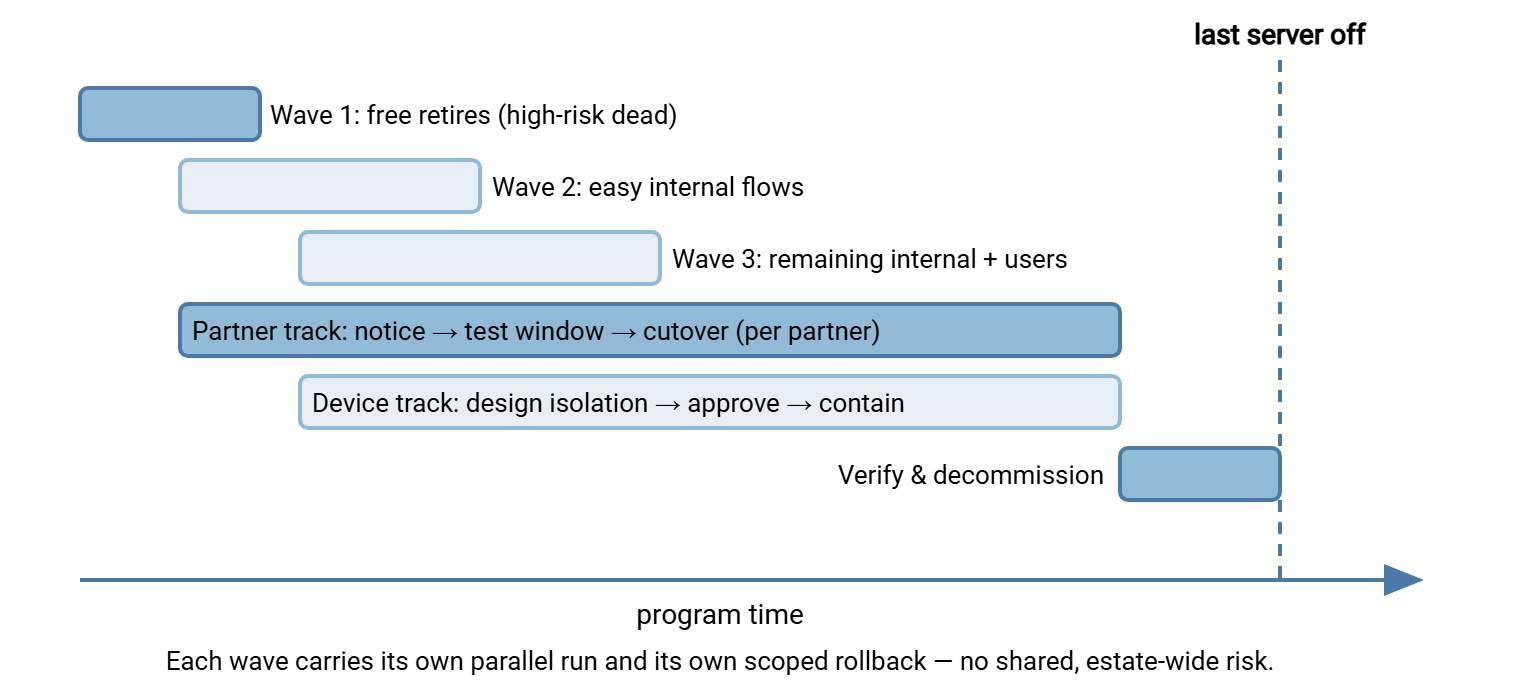
Size waves for comprehension, not speed. A wave should be small enough that one person can hold its whole state in their head. That means which flows are parallel-running, which are cut over, and which can still roll back. When a wave grows past that, split it. The goal is never to finish fast; it is to never be surprised.
The Double-Run Safety Net
The single most valuable technique in consolidation execution is the double run (or parallel run). The old flow keeps running while the new flow runs beside it. You compare their results before trusting the new one. The double run converts the frightening question — "will the new path work?" — into an evidence question you answer before switching anything off. Applied per flow, the pattern is concrete:
- For a scheduled job: the converted job runs on the new platform into a staging area or with a distinguishing filename, while the original runs untouched. After each cycle, compare outputs — file counts, sizes, and ideally checksums. A run of consecutive clean comparisons is your evidence to cut over.
- For a partner flow: the double run is the test window. The partner sends to the new endpoint while production stays on the old. Both sides confirm arrival and content before the partner's real traffic moves.
- For an interactive flow: both the old and new connection profiles are available together for a grace period. The person switches at their own pace with the old path as a visible fallback.
Two rules keep double runs honest. First, define the exit criteria before the run starts: a fixed number of consecutive clean cycles. Typically, that is three for a daily flow, at least one full real cycle for a weekly or monthly one. This is exactly why the slowest-cycle flows must enter their double run early in the program. Discovering in the final week that a monthly flow has never completed a full parallel cycle is a self-inflicted slip. Second, define the end. A double run with no termination date is not a safety net. It is two production systems, doubling your maintenance instead of halving your risk. When the criteria pass, the old flow is disabled the same day (not deleted), so rollback stays a five-minute option through a short settling period. The per-flow comparison mechanics live in the migration workloads pillar. At the program level, the rule is that no flow cuts over without its double-run evidence in hand.
Redirects and Grace Periods
Not every consumer of a flow can be updated at the moment you cut over. Some are scripts you have not reached yet. Some are partners mid-test, and some are people who have not read the notice. Redirects and grace periods bridge that gap so that "the endpoint moved" does not mean "your transfer failed":
- DNS as a redirect layer. If flows reach the old server by hostname rather than raw IP, a DNS change can point that name at the new platform without every consumer reconfiguring. This is useful for internal flows where the protocol and paths are preserved. It is not magic: it does nothing for hard-coded IPs, and protocol or credential changes still need real reconfiguration. But for a same-protocol move, DNS turns a fleet of cutover tasks into one.
- The grace period on the old endpoint. After a flow's traffic moves, leave the old path alive but monitored for a defined grace period. Anything that still connects to it is a consumer you missed — a script, a person, a partner. The old endpoint's logs during the grace period are your discovery tool for exactly those stragglers. The grace period ends on a date, not on a feeling.
- An informative failure when it finally closes. When the grace period ends, a connection to the old endpoint should fail in a way that tells the connector where to go. That might be a banner, a redirect notice, or a message to a monitored address. It should not be a silent timeout that generates a mystery ticket. A loud, informative failure resolves the last stragglers faster than a clean one.
The grace period is where the double run and the redirect meet. The new flow is proven, and the old path is still catching stragglers. The logs are telling you exactly who has not moved yet. Treat every straggler connection as a register row to close, not as noise. Stragglers are the sweep's second pass, arriving on their own schedule.
At Meridian Parts, the consolidation held together because of one DNS record. When the internal flows moved, the team kept the old hostname, ftp-legacy-03.example.com, as an alias for the new platform. They kept it for a full quarter rather than deleting it on cutover day. In the first month the alias caught fourteen connections from scripts the sweep had missed. Each appeared in the new platform's log with a source address and a username. Each became a register row and a short conversation. By the end of the quarter the alias had gone quiet. The record was removed on the date the plan had set. Nobody noticed, which is the best review a retirement can get. Nobody had to guess who was still using the old name. The name told them.
Decommission Proof
An endpoint is not retired when its traffic moves. It is retired when you have proven it is empty and switched it off in a way you can defend. This is where consolidations most often leave a loose end. The flows move, but the old server keeps running "just in case." A year later it is a mystery box again, sprawl reconstituted from the very estate you were shrinking. "Just in case" is the phrase sprawl uses to ask for another year. Decommission properly, with proof:
DECOMMISSION PROOF — per retired endpoint

[ ] All flows on this endpoint show verdict "cut over" or "retired"
[ ] Grace period elapsed with no unexplained connections in the log
[ ] Final connection log captured and archived (the evidence)
[ ] Data on the endpoint accounted for: migrated, or retained
    per policy, or securely deleted per policy
[ ] Firewall / NAT rules for this endpoint identified for removal
[ ] Credentials/keys for this endpoint revoked, not just disabled
[ ] Service stopped, then host powered off (not yet destroyed)
[ ] Monitoring left in place to catch reconnection attempts
[ ] Owner sign-off that the endpoint may be destroyed
[ ] After a quiet hold period: host destroyed, rules removed,
    register row marked "decommissioned" with the evidence linked
Two lines carry the most weight. Stop the service and power off, but do not destroy immediately. A powered-off host that stays quiet through a hold period is proof nothing depended on it. It is trivially recoverable if something did. Destroy only after the quiet hold. And revoke credentials rather than merely disabling the service. A stopped FTP service with live accounts is a door waiting to be reopened; revoked keys and passwords close it for good. The firewall-rule removal matters too: leaving the rules behind is how a decommissioned endpoint's address becomes an open path to whatever is deployed there next. Pull the rules with the server, using the rule IDs your discovery sweep recorded. Firewall rules do not expire from embarrassment.
The proof is not bureaucracy. It is what lets you tell an auditor, a security review, or a nervous stakeholder that the estate genuinely shrank. You have a captured log per retired endpoint showing it went silent before it went dark. That evidence pack is also the seed of the final program artifact: proof that the consolidation happened. It is analogous to the proof-of-completion discipline our protocol-retirement series builds in proving plain FTP is gone, applied here to servers rather than a protocol.
When a Wave Goes Wrong
Some wave will surprise you. It might be a dependency nobody documented or a partner who cannot make the window. It might be a flow that behaves differently under real load on the new platform. The wave structure is what makes these recoverable rather than catastrophic. Three responses, chosen deliberately:
- Roll back the flow, not the program. Because each wave is small and each flow's old path survives its settling period, a failed cutover reverts one flow in minutes. The rest of the wave — and every earlier wave — is untouched. Re-plan the failed flow into a later wave with what you learned; do not let one flow's problem stall the program.
- Grant a time-boxed exception, never a floating delay. A flow that genuinely cannot make its wave gets a documented exception with a named owner and a firm new date. It does not get an open-ended "later." The consolidation's target date holds for everything else; the exception carries its own expiry. This is the same discipline that keeps the whole program from drifting, and the re-sprawl article makes the exception lane permanent.
- Escalate a stuck flow as a priorities problem. A flow stuck for weeks is no longer technical — it is someone declining to act. The fix is the program sponsor, not more engineering. Surface stuck rows in the weekly review by name; sponsors exist to resolve exactly this.
Keeping Score
The program needs a visible pulse, and the triaged register is the scoreboard — no separate status deck that drifts from reality. Each week, count rows by state and publish the two numbers that matter: endpoints remaining and days to the last-server-off date. A flow counts as done only when its evidence says so, never on assurance. That means traffic on the new platform, silence on the old, and grace period elapsed. The consolidated platform's own logging is the arbiter here. A server such as Sysax Multi Server logging every session to file and database means "is this flow really on the new platform?" is a query, not a debate. The same log stream feeds the re-scan that keeps the estate consolidated afterward. Jobs re-platformed onto a scheduler like Sysax FTP Automation report their runs centrally too. So the automation half of the estate is as visible as the server half. When both numbers reach zero, and every retired endpoint has its decommission proof, the execution phase is done.
Remember: two clocks set the program's length, and neither compresses. They are the slowest flow's natural cycle (a monthly job needs a full month to prove) and the slowest partner's lead time. Start the double runs for long-cycle flows and the notices for partners in the program's first weeks, even though both finish near the end. Everything else bends to the schedule; these two set it.
From Executed to Permanent
When the last server powers off with its proof captured, you have done something rare. You have collapsed a sprawled estate onto a designed platform without breaking a flow, and you can prove it. The census that once returned seventeen now returns a handful, each owned, logged, and defended. The attack surface shrank, the audit got shorter, the incident-response question "through what?" now has an answer. I have watched the last server go dark twice. Both rooms were too quiet for the occasion.
But execution buys a consolidated estate; it does not buy a consolidated estate that stays consolidated. The forces that grew the original sprawl — deadlines, acquisitions, autonomy, partner demands, personal tooling, the fear of removal — are all still active the day you finish. Without a deliberate counter, the next census finds seventeen again. The final article, preventing re-sprawl after consolidation, is the kit that keeps this result. It covers the easy onboarding path, the request lane, the periodic re-scan, and the policy backing. Together, these make the consolidated estate the path of least resistance. Somewhere, a deadline is already looking at a spare box.
Frequently Asked Questions
How many flows should one wave contain?
Can DNS changes handle the whole cutover?
How long should a double run last?
Why not destroy the old server as soon as flows move?
What do we do about a partner who misses their cutover window?
How is this different from the migrating-transfer-workloads material?
From the Sysax team: we build secure file transfer software for Windows. Sysax Multi Server is an FTP, FTPS, SFTP, and HTTPS server. Sysax FTP Automation handles scheduled, scripted transfers. Free trials are on the download page.