
Preventing Re-Sprawl After Consolidation
Eighteen months after the last server went dark, a marketing lead with a Friday deadline asks a developer for somewhere the agency can drop files. The developer has a spare VM. That is how it starts again. The estate you just shrank from seventeen servers to three will be back at seventeen within a few years. That is unless you change something other than the server count. The consolidation removed the symptoms. The disease, the set of forces that made a new server the path of least resistance, is untouched by the migration. The day your program declares victory, a project manager somewhere still faces a Friday deadline. An acquisition is still being negotiated, and a partner is still insisting on their own endpoint. If the easiest way to satisfy any of them is still "stand up a new server," the sprawl regrows. In that case, the next team runs your program again from scratch. Sprawl has nowhere to be and all the time in the world.
This final article in our Sprawl Consolidation series is the prevention kit: the four mechanisms that keep a consolidated estate consolidated. They are not exotic, and none of them is technical heroics. They are an easy onboarding path, a request lane, a periodic re-scan, and policy backing. Together they do one thing: make the consolidated platform the path of least resistance. That makes staying consolidated easier than sprawling. Consolidation is a project; staying consolidated is an operating model, and this is that model.
Why Consolidation Regrows
Recall the six forces from how sprawl happens: deadline pressure, acquisitions, departmental autonomy, partner demands, personal tooling, and the fear of touching what works. Every one of them survives your consolidation intact. The migration did not make deadlines less urgent or acquisitions less frequent; it cleaned up their accumulated output once. Prevention means confronting each force with a mechanism that redirects it toward the platform instead of away from it.
The core insight is about resistance. Sprawl grew because, at each decision point, the sprawling choice was easier than the consolidated one. A new box beat negotiating space on the shared server; a personal script beat learning the central scheduler. Prevention does not work by forbidding the easy choice through willpower or memos; those erode. It works by making the consolidated choice the easy one. If onboarding a flow to the platform is faster than standing up a server, people onboard. If the request lane answers in a day, nobody routes around it. Prevention is resistance engineering: lower the friction on the path you want. Then the forces that grew sprawl push toward consolidation instead of against it. Memos erode; a shorter path does not.
Mechanism 1: The Easy Onboarding Path
The first and most important mechanism is a genuinely easy way to get a new flow onto the consolidated platform. This is what competes, moment to moment, with standing up a new server. If onboarding is a two-week ticket through three teams, people will route around it. Every route around it is a seed of new sprawl. The onboarding path has to win on speed and simplicity, not just on policy.
What makes it easy is that the target platform was designed for exactly this, back in the target design. Adding a flow is adding a tenant area and an account within the existing structure — not provisioning, hardening, and documenting a new host. A multi-tenant platform such as Sysax Multi Server makes new-flow onboarding a matter of creating a scoped account with per-area permissions and, for a partner, an IP allow rule. That is minutes of work on a platform that is already patched, logged, and monitored. Compare that with days of work on a new box that is none of those things. Publish this path so it is discoverable. Include a short intake form, a named owner who provisions, a standard turnaround, and a connection-information sheet the requester receives at the end. When the easy path is genuinely easy, the fear-of-friction that drove people to their own servers evaporates.
NEW TRANSFER FLOW — ONBOARDING INTAKE (publish this)

Requester / team:     ____________   Owner (named human): ________
What moves:           file pattern, direction, sensitivity class
Counterparty:         internal team / partner (name + contact)
Trigger & volume:     schedule or event; rough size and frequency
Protocol needed:      SFTP / FTPS / HTTPS / FTP-only (why?)
Retention needed:     how long files should live on the platform

WE PROVIDE BACK (standard turnaround):
  - Tenant area under the right owner, correct permissions
  - Scoped account (directory-backed or built-in) + IP allow rules
  - Connection info sheet with host key / certificate fingerprint
  - The flow added to the register, logging on from day one

No new server. No exceptions needed. This is the fast path.
Mechanism 2: The Request Lane for the Hard Cases
Some requests do not fit the easy path. It might be a partner with an unusual protocol demand, a genuine capacity concern, or a regulatory constraint that seems to argue for separation. The instinct these cases trigger is the old one: "this is special, so it needs its own server." The request lane exists to catch exactly these before they become new sprawl, by giving the hard cases a real hearing instead of a workaround. "This is special" is how every one of the seventeen introduced itself.
The lane is a lightweight review — one owner, or a small group, that unusual requests route to. Its job is not to say no; it is to find the consolidated answer to a request that looks like it needs a bespoke one. Most "we need our own server" requests dissolve under a few questions. In those cases, the unusual protocol is one the platform already speaks. The capacity fear is answered by the platform's real headroom. The regulatory constraint is satisfied by tenant isolation rather than physical separation. The few that survive genuine scrutiny become documented, time-boxed exceptions — a named owner, a real reason, and an end date. They never become silent permanent additions. This exception discipline is the governance backbone of staying consolidated. It is developed in our exceptions process article. The point here is that an exception with an expiry is a controlled tail. An exception without one is just sprawl with paperwork.
Mechanism 3: The Periodic Re-Scan
The discovery sweep you ran to start the program was not a one-time tool — it is the instrument that keeps the estate honest forever after. Sprawl regrows silently, exactly as it grew the first time. So the counter is to look on a schedule rather than waiting for the next audit to find what accreted. Re-run the discovery sweep on a defined cadence, and compare each result against the register:
- A quick automated scan, often. The port scan and listening-service checks are cheap to automate and run on a short cycle. Their job is a single question: is anything listening on a transfer port that is not in the register? Every hit is either a flow you onboarded and forgot to record, or a new sprawl seed — and both need action.
- A fuller sweep, periodically. On a longer cycle, run the whole seven-source sweep — DNS, firewall rules, scheduled tasks, spend records, the human census. The quick scan misses the same things it missed the first time: the client-only flows, the quarterly jobs, the workstation scripts. The full sweep is how you catch sprawl that does not listen on a port.
- The diff is the finding. The value is not the scan; it is the comparison. Anything the scan finds that the register does not know about is a re-sprawl event, caught early while it is one server instead of ten. Investigate every diff: onboard it properly, or retire it.
The re-scan is dramatically cheaper than the original sweep, for one reason: the consolidated platform logs everything centrally. Once flows live on a server such as Sysax Multi Server, "what is really running on the platform" is a query. Its activity logging writes every session to file and database. In that situation, the re-scan is mostly a matter of confirming that nothing lives outside the platform. The same central logging makes the periodic access review — who can reach what, and whether they still should — a routine report rather than an investigation. Schedule both the re-scan and the access review as recurring calendar events with named owners, because an unscheduled good intention is not a control.
Northgate Retail's first quarterly scan after the consolidation returned one row the register did not have. It was an SFTP listener on a new VM in the marketing subnet. It had been stood up the week before by an agency-integration project with a Friday deadline, for the oldest reason there is. Nobody on the project knew the onboarding path existed. Nobody got a lecture; the missing link had been the problem, not the project. The flow was onboarded as a tenant the following Monday. The VM came down that afternoon. The intake form got a link from the project-kickoff template so the next project would find it first. One server, caught at one, is what the re-scan is for; the same server found three years later has friends.
Mechanism 4: Policy Backing
The three mechanisms above are the carrot — the easy path, the responsive lane, the watchful re-scan. Policy is the frame that makes them stick, by stating plainly what the organization has decided about how files move. Without written policy, every prevention mechanism depends on the memory and goodwill of whoever runs it. With policy, the mechanisms are the organization's stated way of working, and they survive the person who set them up. Goodwill has a turnover rate.
Two policy statements do most of the work:
- An approved-and-forbidden-methods list. The consolidated platform (and its scheduler for jobs) is the approved way to move files. Standing up an independent transfer server is not an approved method. Stated once, clearly, this converts "please don't make new servers" from a plea into a rule with a reason. Our approved and forbidden methods article is the template. The consolidation gives it teeth, because now there is a genuinely usable approved method to point people toward.
- A change-control gate on new endpoints. The provisioning process for a new server includes a checkpoint. Is this a transfer endpoint, and if so, why is it not a tenant on the platform? The gate does not forbid new servers; it forces the question, and the question is usually enough. Most would-be new servers fail to justify themselves once someone asks. The gate is where the request lane and the policy meet the actual moment of creation.
Policy without the mechanisms is a memo nobody follows; the mechanisms without policy are goodwill that erodes. Together they are an operating model. The broader discipline is writing rules people actually follow — and keeping the policy alive rather than shelved. That is the subject of our file transfer policy series. A consolidation is the ideal moment to establish that discipline, because you have just proved the cost of not having it.
The Prevention Kit, Assembled
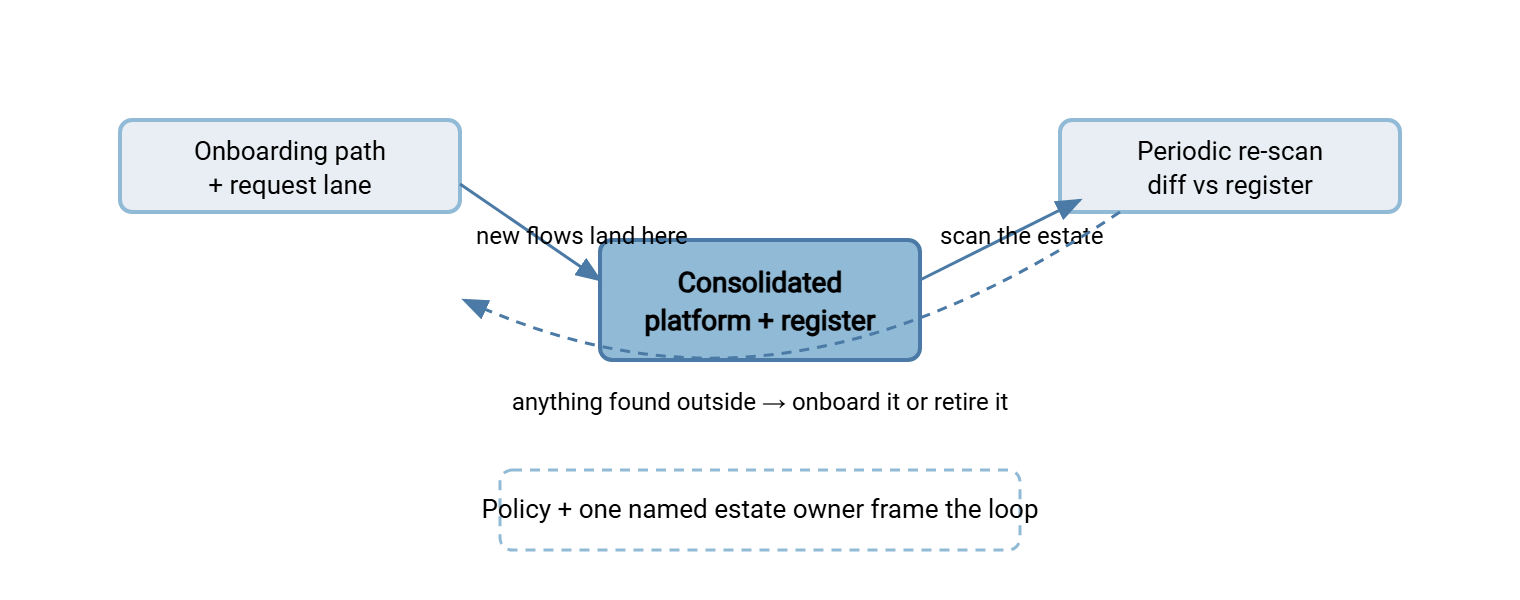
The four mechanisms reinforce each other, so treat them as one system rather than four initiatives. Here is the kit as a standing operating model — the thing you hand to whoever owns the estate after the project team disbands:
RE-SPRAWL PREVENTION KIT — the standing operating model

ONBOARDING PATH (the carrot)
  - Published intake form; named provisioner; standard turnaround
  - New flow = tenant + account on the platform, in minutes
  - Faster than standing up a server (that is the whole point)

REQUEST LANE (the pressure valve)
  - Unusual requests route to one reviewer / small group
  - Job: find the consolidated answer, not to say no
  - Survivors become time-boxed exceptions with an end date

PERIODIC RE-SCAN (the smoke alarm)
  - Quick automated port/service scan: often
  - Full seven-source sweep: periodically
  - The diff against the register IS the finding — act on every one

POLICY BACKING (the frame)
  - Approved methods = the platform; new servers are not approved
  - Change-control gate: "why is this not a tenant on the platform?"
  - Exceptions documented, owned, and expiring — never silent

OWNERSHIP
  - One named human owns the estate and this kit. The absence of
    this role is what let sprawl grow unowned the first time.
The last line is the one that fails most often and matters most. Sprawl grew, originally, because the estate had no owner. Servers had owners, and scripts had authors. But the question "how many transfer endpoints should we have?" belonged to no one. If the consolidation ends and that ownership gap reopens, the kit has no one to run it. In that case, the estate drifts back to unowned by default. Name the owner of the consolidated estate explicitly, give them the kit, and make running it part of the role rather than a side project. An operating model without an owner is just a document. I have inherited that document once. It was well written and entirely unread.
A Light Touch, Sustained
Prevention is deliberately light. The kit is not a bureaucracy — a heavy one would itself drive people to route around it, recreating the problem. It is a small set of standing commitments. Keep the onboarding path fast and answer the request lane promptly. Run the re-scan on schedule and keep the policy current. Make sure someone owns all four. The effort is modest and continuous, which is exactly the opposite of the consolidation project itself — a large, finite burst. That contrast is the whole point: pay a little attention continuously and you never pay the large burst again. Smoke alarms are cheaper than fire crews, and considerably quieter.
The alternative is the cycle most organizations are stuck in: sprawl, a painful consolidation, relief, drift, and sprawl again. They run the same expensive project every few years because nothing was done to break the loop. The prevention kit breaks it. It is the difference between a consolidation that was a project and a consolidation that became the way the organization works.
Remember: you cannot forbid sprawl into submission — memos and prohibitions erode, and every eroded prohibition is a new server. You can only out-compete sprawl by making the consolidated platform the genuinely easier choice. Lower the friction on the path you want until the forces that grew the sprawl push toward the platform instead of away from it. Prevention is resistance engineering, not enforcement.
Closing the Series
That is the arc of a consolidation, end to end. Understand how sprawl happens. Then discover every server and script. Next, triage it into keep, merge, and retire. Then design the platform it collapses onto. Next, execute the moves without breakage. Then keep it consolidated with the kit in this article. The first five articles get you a small, owned, defensible estate. This last one keeps it that way. In the end, that is the only version of consolidation worth the effort, because a consolidation that regrows was just an expensive pause. Somewhere, a developer still has a spare VM. Now there is a better answer.
Frequently Asked Questions
How often should we re-scan for new sprawl?
Won't a request lane just slow everyone down and get bypassed?
What is the single most important prevention mechanism?
Do we need a formal policy, or is a good platform enough?
Who should own the consolidated estate long-term?
An acquisition just arrived with its own transfer stack. What now?
From the Sysax team: we build secure file transfer software for Windows. Sysax Multi Server is an FTP, FTPS, SFTP, and HTTPS server. Sysax FTP Automation handles scheduled, scripted transfers. Free trials are on the download page.