
Finding Your Tipping Point: A Worksheet
Two engineers, one worksheet, forty-five minutes, and on factor four they have written different numbers before anyone has said a word. That is the scene this article is built for. Our Build vs Buy series has so far produced arguments and evidence. There is the build case with its conditions checklist, and the cost ledger with its bus-factor test. There is also the buy case with its trial drill. What none of them produced is a decision. This article is the scale: a twelve-factor worksheet that turns your evidence into a score. Three bands turn the score into a direction. Three fully worked examples — one landing on build, one on buy, one on mixed — let you see the arithmetic behave before trusting it with your own estate.
Two commitments up front. First, "keep building" is a real output of this worksheet, reached by real estates. Worked example one shows the profile that reaches it — this is not a funnel with a purchase at the bottom. Second, the scoring is designed to be audited. Every factor cites the evidence that feeds it, and two factors deliberately score against buying. The rules require your most skeptical engineer to score independently. If the worksheet is rigged, those features make it easy to catch us.
What the Worksheet Needs, and What It Cannot Do
Gather four inputs before scoring; without them you are scoring vibes, and vibes are what the hallway argument already ran on. You need a flow inventory (the census from the automation inventory article, or an honest afternoon's list). You need a quarter of tracked care hours from the cost-ledger article and the bus-factor test results with actual names and blanks. And — if you have run one — you need the notes from a trial drill. Missing inputs default the affected factors to the middle score, not the favorable one, and get flagged for follow-up. The sheet extends nobody the benefit of the doubt.
A word on who is publishing this, because it bears directly on trust: Sysax sells transfer software. A vendor publishing a decision worksheet deserves your raised eyebrow. Audit the math rather than trusting it. Every factor below is symmetric — each has a genuine zero that real teams earn. Factor eleven scores weird flows toward building because that is where products honestly underperform. Factor twelve scores team depth the same direction, and the override rules can nullify a high score entirely. Run the numbers with your most build-loyal engineer holding the pen and see where they land; that experiment is the whole integrity claim.
The Worksheet
Score each factor 0, 1, or 2 using the anchor descriptions. Do not interpolate, do not average impressions — pick the anchor that is closest to your evidence, and write down which evidence. Total the twelve. A 1.5 is an opinion wearing a decimal point.
THE TIPPING-POINT WORKSHEET  (score 0, 1, or 2 per factor)

 1. FLOW COUNT            0: under ten   1: ten to thirty
                          2: over thirty
 2. GROWTH                0: flat for a year or more
                          1: a few new flows or partners a year
                          2: new flows or partners most months
 3. FAILURE STAKES        0: internal inconvenience only
                          1: business friction, recoverable
                          2: contractual, financial, or regulatory
                             damage when a flow fails
 4. BUS FACTOR            0: a named second has fixed each key
                             flow alone (rehearsed, recent)
                          1: partial cover, some blanks
                          2: blanks on critical flows, or the
                             author is leaving
 5. MEASURED CARE HOURS   0: light, mostly scheduled work
                          1: noticeable, some interruptions
                          2: an engineer-week or more a quarter,
                             or mostly interruptions
 6. AUDIT EXPOSURE        0: nobody asks for transfer evidence
                          1: occasional questionnaires
                          2: recurring audits with deadlines
 7. DELEGATION NEED       0: authors operate their own flows
                          1: others operate occasionally
                          2: helpdesk or shifts must operate
                             flows they cannot read
 8. CONDITIONS CHECKLIST  0: all nine build conditions hold
    (from the build case)  1: gaps exist, with a funded plan
                          2: same gaps for several quarters
 9. NEW-FLOW COST         0: about a day, via shared code
                          1: several days
                          2: a week or more, or copy-paste forks
10. PARTNER CHURN         0: endpoints and formats rarely change
                          1: something changes most quarters
                          2: something changes most months
11. FLOW WEIRDNESS        0: most flows carry bespoke judgment
    (reverse-scored:          or logic no product anticipates
     weird favors build)  1: an even mix
                          2: mostly standard patterns - pickups,
                             drops, mirrors, scheduled sends
12. TEAM SCRIPTING DEPTH  0: fluent team, succession realistic
                          1: one strong scripter plus partial
                             cover
                          2: thin skills or no appetite to
                             maintain scripting craft

TOTAL: ___ of 24

  0 -  8   KEEP BUILDING - the position is held and cheap.
            Re-score yearly or on any override event.
  9 - 15   MIXED ZONE - buy the layers where your points
            concentrate; keep building where they do not.
            Score flow groups separately before deciding.
 16 - 24   BUY PRESSURE IS REAL - run the trial drill and
            plan a transition; the estate is telling you.

OVERRIDES (trump any total, in either direction)
 TOWARD BUILD: a trial proved no candidate product can carry
   your core flows; or custody/architecture rules exclude
   available tools. The score is moot - build, and invest in
   the conditions checklist.
 TOWARD BUY: the author has resigned with blanks in the bus
   test; or an audit finding sets an evidence deadline your
   log drawer cannot meet. Continuity emergencies outrank
   arithmetic.

HONESTY RULES
 - The estate's chief skeptic and chief advocate score
   independently; reconcile any factor differing by 2 with
   evidence, not seniority.
 - Every factor cites its source (inventory, ledger, bus
   test, trial notes). No source, score the middle, flag it.
 - Score subsets separately when the estate splits naturally
   (partner-facing vs internal is the classic seam).
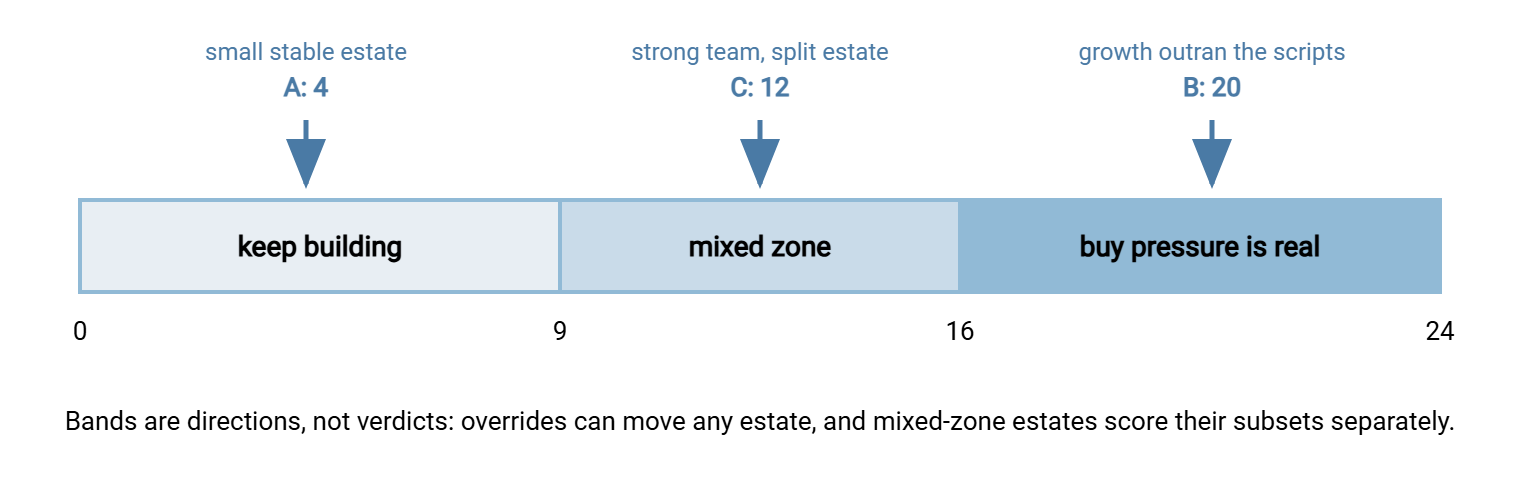
The bands, drawn to scale, with the three worked examples from below already plotted:
Two People, One Sheet: How the Scoring Session Actually Runs
The mechanics matter more than they look. Book forty-five minutes. The estate's chief skeptic of buying — usually the script author — and its chief advocate each fill in the sheet beforehand, alone, citing evidence per factor. The session walks the twelve factors comparing answers, and the gaps are where the meeting earns its calendar slot. Agreement is pleasant and teaches nothing.
The divergences are predictable and diagnostic. On bus factor, the advocate writes 2 and the skeptic writes 0, citing "Sam could figure it out". At that point the rule bites: could is not the anchor; has, alone, recently is. The reconciliation either produces the date Sam actually did or the score is 1 at best and the rehearsal goes on next sprint's plan. On care hours, the pattern inverts: the author, who pays the interruptions, scores high while the manager, who never sees them, scores low. The ledger settles it, which is why the ledger exists. On weirdness, both tend to overclaim in opposite directions; walking the actual inventory flow by flow settles that one. A factor where neither party can cite a source scores the middle and lands on the homework list. The sheet is allowed to say "measure first," and for unmeasured estates that is its most common and most useful verdict. I have scored from memory once; the sheet agreed with me, which should have been the warning.
Bluewater Bank's session produced the textbook divergence. The advocate scored bus factor at 2; the author scored it at 0, on the grounds that a colleague "could pick it up." The reconciliation rule asked for a date, and there was not one, so they made one. The colleague took the next failure alone, with the author in a different building. It took her four hours, two of them finding which host held the log, and the flow was fixed correctly. The factor was re-scored at 1, with the date attached, and the rehearsal went on the quarterly calendar. Both scorers had been wrong; only the sheet had been right.
Write the final sheet up with each factor's evidence in one line. That document — twelve numbers, twelve citations, a date — is what the budget owner sees. It slots straight into the one-page business case. It is a different genre from the hallway argument, disputable only by disputing an input. It is very hard to argue with a citation at volume.
Remember: the worksheet prices this quarter's facts, not anyone's identity. A build score is not a promotion and a buy score is not an indictment. Both are photographs of an estate at a moment, taken so the next move can be argued from evidence instead of loyalty.
Worked Example A: The Estate That Should Keep Building
An operations team at a mid-sized manufacturer runs seven flows: nightly exports to a logistics partner, internal report drops, a weekly regulator-adjacent send that has never changed. One partner in five years. Two engineers write and maintain everything. After a rough patch last year they added external monitoring, rehearsed a handoff, and started logging care hours. Those hours came out light and almost entirely scheduled. Nobody audits them beyond an annual internal checkbox. Three of the seven flows embed genuinely bespoke validation logic that grew out of hard experience.
Their scores begin with flow count 0, growth 0, stakes 1 (a missed logistics file causes real but recoverable friction). Then come bus factor 0 (rehearsed, recent), care hours 0, audit exposure 0, delegation 0, conditions 0. Next are new-flow cost 1 (several days — they build carefully), churn 0, weirdness 0 (bespoke logic dominates). Finally, team depth scores 1 (fluent pair, but succession is a fair question). Total: 4. Keep building.
Read what the number is actually saying, because this is the profile vendors' marketing pretends not to exist. It is a held position, empirically cheap, with fit advantages a product would erase. The worksheet's only homework for this team is factor twelve — succession — and a calendar note to re-score if the partner count or the audit regime ever changes. Buying here would spend a migration to acquire capabilities their practices already deliver. The verdict is not "scripts got lucky"; it is the build case, confirmed by arithmetic. This paragraph appears in no vendor deck, including ours.
Worked Example B: The Estate That Tipped
A distribution company grew from four retail partners to nineteen in three years, and the scripts grew the same way: by copy-paste. Thirty-eight flows, two or three new ones a month as the sales team lands accounts. A missed feed now triggers contractual chargebacks. The original author — the only person who understands the older half of the estate — has given notice. Customer security reviews arrive quarterly and each one costs days of log archaeology. Helpdesk cannot touch failures; everything escalates. The care ledger, kept for one quarter, showed more than an engineer-week of interruptions. The flows themselves are almost embarrassingly standard: scheduled pickups, drops, and mirrors. Nothing about this estate is unusual except that someone counted.
Scores: 2, 2, 2, 2, 2, 2, 2, 2 (the conditions gaps date back six quarters), 2, 1, 2 (standard patterns — reverse-scored toward buy), and 1 for team depth after the departure is backfilled. Total: 20 — and the resignation triggers the buy-side override anyway. This estate is past its tipping point and has been for a while; the score merely says out loud what the interruptions were saying quietly.
What happens next matters as much as the verdict. The team ran the two-week trial drill from the buy-case article against their three ugliest flows. The drill works identically with any candidate; one of theirs happened to be our Sysax FTP Automation. The departing author drove the trial, which converted the migration plan from a manager's hope into an engineer's checklist. Not incidentally, the trial became the best knowledge-transfer exercise of the author's notice period. That was because every task rebuilt in the trial forced the undocumented assumptions out of their head and into task definitions a successor can read. Two flows stayed scripted even in the final plan, because they carry logic no product models. The plan says so in writing rather than pretending they will migrate someday. A buy verdict is a direction for the estate's center of gravity, not a purge.
Worked Example C: The Estate That Should Split
A software company with a strong platform team runs about twenty-five flows. Internally: build artifacts, data moves between environments, analytics drops — deeply entangled with in-house systems, fluently maintained, version-controlled, monitored, cheap on the ledger. Externally: eight enterprise customers exchange files over standard protocols, each with security questionnaires, evidence requests, and account-management needs, and the sales pipeline promises more. The external flows are operated, awkwardly, by the same platform engineers who would rather not be, and customer-facing evidence requests interrupt sprints. Questionnaire season, like tax season, arrives whether or not you planned for it.
Scored as one estate, the first factors are flow count 1, growth 1, stakes 1, bus factor 0, care hours 1, audit exposure 2. Then come delegation 1, conditions 0, new-flow cost 0, churn 1, weirdness 1 (a true mix), team depth 0. Total: 9 — bottom of the mixed zone, and unsatisfying. So they applied the subset rule and scored the two halves separately. The internal estate alone: roughly 3 — keep building, plainly. The customer-facing estate alone: stakes 2, audit 2, delegation 2, churn 2, weirdness 2 (standard protocols, standard patterns), totaling around 15–16 — buy pressure, unmistakably.
The mixed verdict wrote its own architecture: a bought transfer server on the customer-facing edge. It provides per-account authentication against the existing directory, IP rules, uniform activity logging that turns questionnaire season into queries. That is the shape of a product like our Sysax Multi Server, verified in a trial before anyone committed. Meanwhile, the internal estate stays scripted, on the merits, indefinitely. One decision, two correct answers, because the estate was always two estates wearing one name. This outcome is common enough that we would call the subset rule the single most valuable line in the worksheet.
After the Score
Whatever band you land in, three disciplines keep the result honest over time. First, date the score and diarize a re-run — yearly, or immediately on override events: a resignation, an audit finding, a doubling of flows, a big new partner. Tipping points are crossed in motion, and the estates that suffer are the ones that scored once and framed it. Second, validate before committing: a buy or mixed verdict earns a trial drill against your own flows. Free trials exist, ours included, precisely so this validation costs an afternoon of setup rather than a signature. A build verdict earns the conditions checklist with this quarter's gaps assigned to names. Third, treat the transition itself as its own engineering problem, in either direction. Moving flows without breaking them, running pilots beside scripts, and keeping your exit open are the craft of the final article in this series. Skipping that craft is how correct verdicts still produce regrettable years.
And if the score surprised you — in either direction — that is the worksheet working. It has surprised us in both directions, and we wrote the thing. The hallway argument ran on the loudest anecdote; the score runs on your inventory, your ledger, your blanks, and your trial notes. Disagree with it only by disagreeing with an input, out loud, with the evidence on the table. That discipline, more than any total, is what this series has been building toward.
Frequently Asked Questions
How do we know the scoring isn't rigged toward buying?
What if our score lands right on a band edge?
Can we skip the ledger and bus test and just score from experience?
Why does flow weirdness score toward building?
Our score said buy, but the budget owner disagrees. Now what?
How often should a stable estate re-score?
From the Sysax team: we build secure file transfer software for Windows. Sysax Multi Server is an FTP, FTPS, SFTP, and HTTPS server. Sysax FTP Automation handles scheduled, scripted transfers. Free trials are on the download page.