
The One-Page Business Case: Template and Walkthrough
Everything in this series so far has produced evidence. That includes a risk scenario with a likelihood and an impact, and a worksheet of hours from your own logs. The evidence also includes an audit finding with a signature and a date. None of it is a business case yet. A business case is the single page that puts those three things in front of one person and asks them to decide. If it takes more than a page, the reader will decide something else first, usually lunch.
This article is the page. It explains what the page has to do and the seven blocks that do it. It explains how to present the three options (do nothing, fix what you have, replace it). The aim is for the reader to believe you considered all of them. The article also explains how to give a cost as a shape rather than a spreadsheet. Finally, it shows how to end with a sentence a person can say yes to. Then it fills the template in for Meridian Parts, a spare-parts distributor with forty flows and two administrators. That lets you see a finished one before writing your own. This article is the center of our Business Case series. The earlier articles produce its inputs and the last one takes it into the room.
What One Page Has to Do
The page has one reader and ninety seconds. The reader is whoever can approve the spend. They will read the first paragraph, skim the options, look at the cost line, and read the last sentence. If those four things make sense together, they will read the middle. If not, they will ask a question, and it will be about whichever of the four was weakest.
Seven blocks do the work, in this order. A problem statement: what moves, who depends on it, what fails, and what it costs, in one paragraph. The evidence: three lines, one each for risk, operational cost, and audit. The options: at least three, each with what it closes and what it leaves open. A recommendation: one option, one sentence of reason. The cost shape is for the recommended option. It shows the up-front bump, the flat ongoing cost, and any spikes, in hours and fractions of an existing budget line. The ask: the specific thing you want approved, which is usually a pilot rather than the whole program. And the decision requested: one sentence, starting with those two words, that a person can answer with yes or no.
Three terms deserve a definition. The ask is the concrete thing being approved: not "support for transfer modernization" but "a four-week pilot with two suppliers, funded from the existing support line." A pilot is a time-boxed trial of the recommended option on a small part of the estate, with a report back at the end. It exists so the reader can say yes to something small and reversible. And the decision requested is the last line on the page, the one that turns a document into a question. Most failed cases I have seen did not lack evidence. They lacked that line.
The Three Options: Do Nothing, Fix, Replace
Every case has at least three options, and the reader needs to see all three treated fairly. A case with one option is a sales pitch, and readers can tell within a paragraph. Do nothing is not a placeholder. It is the option the organization has chosen every year so far. It has a cost shape like any other: no bump, a flat line of hours that rises as the scripts age, and spikes whose timing nobody chooses. Write it out honestly, including what it does well (it costs nothing this quarter).
Fix what you have means keeping the current server and scripts and adding the missing controls around them. Those include alerting bolted onto the scheduler, encryption enabled where the existing server supports it, a log shipped somewhere it will be kept. This option is often the cheapest and sometimes the right one. The case must say what it closes and what it cannot. The second half is where honesty earns its keep. If the existing server cannot issue one login per partner, say so, because the auditor will.
Replace splits three ways: build it yourself around better scripts and a proper scheduler, adopt a free or open-source tool, or buy a commercial one. We make transfer software, so read this paragraph with that in mind. The template works whichever you choose. A free or open-source outcome is a perfectly good result of a well-made case. The argument about where build ends and buy begins is not repeated here. It lives in build versus buy, honestly. A worksheet for finding your own tipping point is in the tipping-point assessment. Whether you need a full managed file transfer platform or something simpler is answered in do you need MFT? The case should say what is needed rather than what the category is called.
On the page, each option gets three lines: what it costs (as a shape), what it closes, what it leaves open. If you cannot write the "leaves open" line for your recommended option, you have not finished thinking about it, and the reader will finish for you.
Cost Shape Without Spreadsheet Theater
Spreadsheet theater is the fourteen-tab workbook attached to a request. Every cell is an estimate, and the total on the summary tab is quoted to the nearest unit. The workbook looks rigorous. It is a list of guesses multiplied together, and the reader knows it, because they have built one themselves. Worse, it gives the reader something to find: a wrong formula on tab nine, and the meeting is now about the workbook.
Acme Logistics learned this in a single afternoon. Their transfer case arrived with a workbook that costed the replacement to the hour over five years. The finance director, who enjoys spreadsheets, opened it during the meeting. Tab nine contained a formula that double-counted the migration hours. The error made the case look worse, not better, but the finding ended the discussion. The request was returned "for correction" and did not come back that year. The rewrite was one page, with the cost as three lines of hours and a note that finance's own rates should be applied. It was approved without the workbook being opened.
The alternative is the cost shape. For each option, it shows an up-front bump, a flat ongoing part, and any spikes, each in units the reader already trusts. The bump is in administrator hours or weeks ("about three weeks of one administrator"). The flat part is a fraction of an existing line ("within the current support line" or "less than a tenth of it") or hours a month. Spikes are named ("a license renewal every year"). Money appears nowhere on the page; finance converts hours using their own rates and trusts the result because it is theirs.
The diagram below shows the three shapes side by side. Do nothing has no bump, a rising flat, and spikes nobody schedules. Fix has a small bump, a flat that stays roughly where it is, and fewer spikes. Replace has a larger bump, a lower flat, and spikes you can put on a calendar.
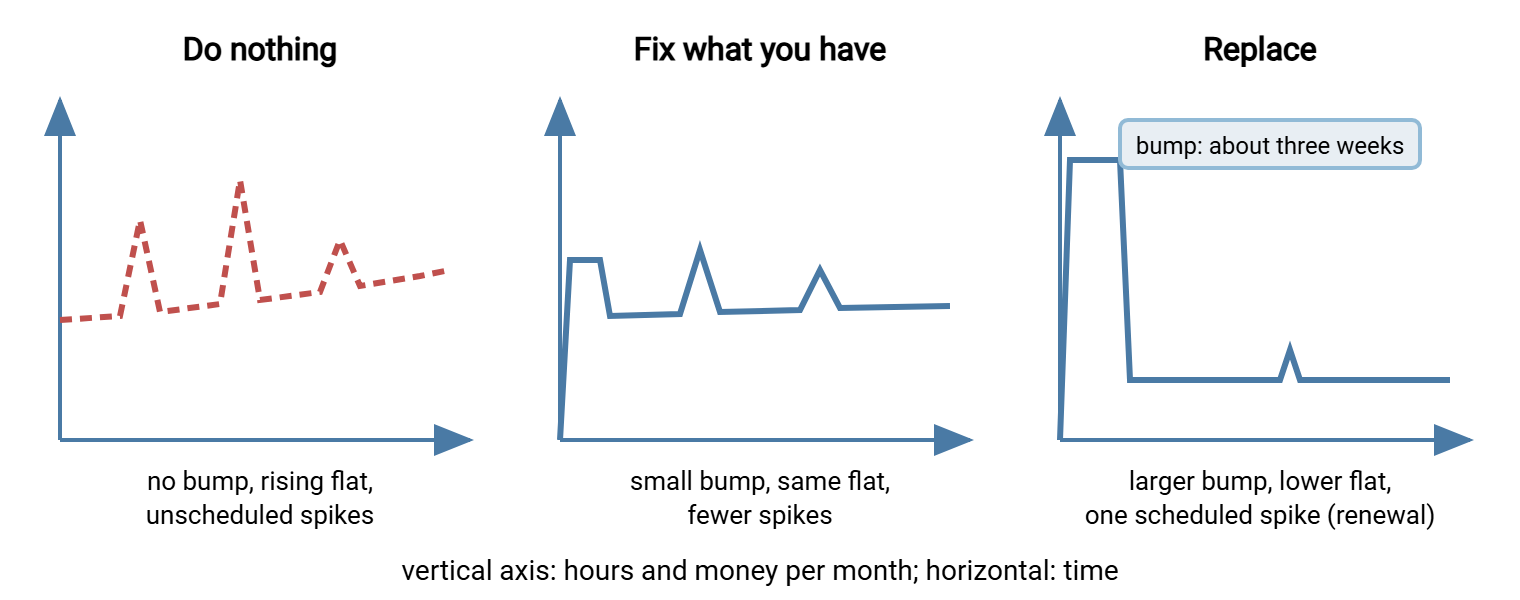
One useful trick is to express the bump as a multiple of something the reader already knows. Meridian's replacement costs about three weeks of one administrator, roughly the firefighting hours from their one bad quarter. "The up-front cost is about one bad quarter's worth of the work it replaces" needs no spreadsheet. The reader can check it against the worksheet from costing failed jobs and manual work at a glance.
Remember: the cost line is not trying to be precise. It is trying to be checkable. Three lines of hours and fractions the reader can verify against their own records beat fourteen tabs they have to take on trust.
The Specific Ask and the Decision Requested
The ask is smaller than the recommendation. You recommend replacing the estate; you ask for a pilot. This is not timidity. A pilot is the version of yes a careful person can give on the day. It is small, time-boxed, funded from a line that already exists, and reversible if the report back disappoints. It also produces what the follow-through needs most: a result in the same units as the case. If the case said "silent failures cost purchasing seventy hours a year," the pilot report can say "in four weeks, zero silent failures on the two pilot flows."
The decision requested is one sentence and it is the last thing on the page. It names the option, the first step, the funding line, the date, and the report back. A reader can say yes to it, or no, or "yes but three suppliers." All three are progress. "We hope you will support this initiative" produces none of them. Then say what happens if the answer is no, briefly and without drama. You can write: "If not approved, finding 4.2 remains open and will be reported as a repeat finding." That is not a threat; it is the do-nothing option, restated at the point where the reader is choosing.
Template: The One-Page Business Case
The skeleton below fits on one printed page if you are disciplined. Everything in square brackets is yours to fill; everything else is structure. Do not add a block. If something does not fit into these seven, it belongs in the appendix.
BUSINESS CASE: [short title]                                        [date]  [author]

1. PROBLEM
   [What moves, for whom, by when. What fails, how often, how many silently.
   What it cost last period in hours by role. One concrete consequence.
   One quoted sentence from an outsider: auditor, insurer, or partner.]

2. EVIDENCE (detail in appendix)
   Risk:        [scenario]: [likelihood] and [impact] today; [after] with option [x].
   Hours:       [total] a year today ([by role]); about [total] after; [which real].
   Audit:       Finding [ref] ([severity]): "[verbatim]". Accepted; due [date].

3. OPTIONS
   A. Do nothing.       Cost: [flat hours continue; spikes]. Closes: nothing.
                        Leaves open: [finding], [risk], [hours].
   B. Fix what we have. Cost: [bump] + [flat]. Closes: [ ]. Leaves open: [ ].
   C. Replace.          Cost: [bump] + [flat] + [spikes]. Closes: [ ]. Leaves open: [ ].
                        [Build / open-source / commercial: which, and why, in one line.]

4. RECOMMENDATION
   Option [x], because [one sentence].

5. COST SHAPE OF THE RECOMMENDED OPTION
   Bump:   [hours or weeks of whom]
   Flat:   [fraction of which existing line, or hours a month]
   Spikes: [named and scheduled]
   Headcount: [unchanged / avoided hire / freed hours and where they go]

6. ASK
   [The pilot or first step: scope, duration, funding line, who does the work.]

7. DECISION REQUESTED
   [One sentence: option, first step, funding, start date, report-back date.]
   If not approved: [one sentence, the do-nothing consequence].
Walkthrough: Meridian Parts, Filled In
Here is the same page for Meridian Parts, built entirely from the scenario card, the worksheet totals, and the audit memo in the earlier articles. Read it once as the operations director would, in ninety seconds, and then read the commentary.
BUSINESS CASE: SUPPLIER AND DEALER FILE TRANSFERS          IT (transfer services)

1. PROBLEM
   We exchange about sixty files a day with twelve suppliers and four dealer
   groups: price lists, purchase orders, stock feeds, dealer invoices. Purchasing
   and the warehouse need them before 06:00. Last quarter twenty-two transfers
   failed or were late, nine silently; one left the catalog at last month's
   prices for nine days. The scheduler has no retry, alerting, or central log, and
   four suppliers share one password on an unencrypted service. Transfer work
   cost about 575 hours last year: 357 administrator, 198 purchasing, 20 director.
   The auditor: "supplier files are exchanged over an unencrypted service using a
   credential shared by multiple parties."

2. EVIDENCE (detail in appendix)
   Risk:   Shared supplier password leaks: likely and major today; rare and minor
           with option C.
   Hours:  575 a year today; about 155 after option C. Of the 420 freed, the 168
           in purchasing are real capacity in a team that requested a hire.
   Audit:  4.2 (high) and 4.5 (medium), both accepted, 4.2 due before next review.

3. OPTIONS
   A. Do nothing.       Cost: 575 hours a year, rising; spikes unscheduled.
                        Closes nothing. 4.2 becomes a repeat finding.
   B. Fix what we have. Cost: about three weeks of one administrator, then the
                        current maintenance hours. Closes 4.5; frees about 200
                        hours. Leaves 4.2 partly open: the current server cannot
                        issue one login per supplier. Risk stays at likely.
   C. Replace.          Cost: about three weeks of one administrator to migrate
                        twelve suppliers and forty jobs; ongoing within the
                        existing support line; one renewal a year. Closes 4.2 and
                        4.5; frees about 420 hours. Commercial server plus
                        scheduled-transfer tool shortlisted against one
                        open-source pairing; comparison in appendix.

4. RECOMMENDATION
   Option C, because B leaves the high-rated finding open at the next review for
   nearly the same up-front effort.

5. COST SHAPE OF OPTION C
   Bump:      about 120 administrator hours, roughly one bad quarter's firefighting.
   Flat:      within the existing support line; less than a tenth of it.
   Spikes:    annual renewal; none in the first year.
   Headcount: unchanged. Administrator hours freed go to the change backlog;
              purchasing hours freed remove the case for the requested hire.

6. ASK
   A four-week pilot: two suppliers and the daily purchasing uploads moved to the
   shortlisted option, run by the two administrators, funded from the support line.

7. DECISION REQUESTED
   Approve option C in principle and fund the four-week pilot from the existing
   support line, starting next month, with a decision on full rollout at the
   pilot report.
   If not approved: 4.2 remains open and is reported as a repeat finding.
Now the commentary. Block one contains no protocol names and one quoted outsider, and its numbers are the ones the worksheet and the scenario card can defend. Block two is three lines because the reader will not read four. Block three treats option B fairly, including the part it closes and the honest reason it is not recommended. The sentence giving that reason makes the recommendation believable. Block five gives the bump as a multiple the reader already knows and the flat part as a fraction of a line that already exists. Block seven asks for something small and reversible and says what "no" means.
Notice also what the page does not do. It does not name a product in block three. It says "commercial server plus scheduled-transfer tool" and points at the appendix. The shortlist lives there with its open-source alternative beside it. A product name on the page invites a conversation about the product. A control description invites one about the control, which is the one you want. For example, suppose the appendix shortlist includes Sysax Multi Server for the encrypted, per-supplier, logged service. In this example, it also includes Sysax FTP Automation for the scheduled jobs with retry and notification. In that case, it should show the open-source pairing in the same columns, costed the same way.
The appendix holds everything the page points at, in the order the page mentions it. First come the risk scenario card, the worksheet before and after by role, and the finding-to-control-to-spend table and memo. Next comes the option costing with assumptions the reader can change. Then come the shortlist with build, open-source, and commercial candidates in the same columns, and the pilot design. Nobody has to read the appendix for the page to work. It exists so you can say "it's in the appendix, section three" instead of "I'll get back to you." That is often the difference between a decision today and a decision next quarter.
Before You Send It
A short check, done the night before. Every item is something I have got wrong at least once.
- The problem statement names the business thing carried, not the mechanism, and quotes one outsider.
- Every number on the page traces to a log, a tally, a signed response, or a card in the appendix.
- No currency figure; hours, fractions, and multiples only. No statistic from a study.
- Do nothing is written out honestly, including what it does well.
- The cheaper option's "closes" line is complete and its "leaves open" line is true.
- A free or open-source path appears in option C, costed the same way as the commercial one.
- The cost shape has a bump, a flat, and named spikes; the headcount line says which freed hours are real.
- The last sentence begins "Decision requested" and can be answered with yes.
- It fits on one page. If not, the appendix is too thin and the page is too fat.
Gotcha: the reader's credibility with their own finance team matters more than any single yes. A case that wins by overstating will be remembered at the next request, and there is always a next request. Write the page you could defend line by line to the most skeptical person in the building, because that is who will read it.
The page is finished when it can be read in ninety seconds and answered in one word. The last article, presenting the case and following through, covers what happens when the page is read aloud and the objections that follow. It also covers how to run the pilot so its report lands in the same language. And it covers how to keep the funding once the crisis fades. And if you are still wondering why a page this short is necessary at all, the request competes with a demo. The page is the closest thing to a demo a transfer estate will ever have.
Frequently Asked Questions
Does it really have to be one page?
Should the page name the product I want?
What if "fix what we have" is genuinely the best option?
Why ask for a pilot instead of the full rollout?
From the Sysax team: we build secure file transfer software for Windows. Sysax Multi Server is an FTP, FTPS, SFTP, and HTTPS server. Sysax FTP Automation handles scheduled, scripted transfers. Free trials are on the download page.