
Transitioning Between Build and Buy Without Regret
Monday, nine a.m., the weekend cutover is "done," and the first partner call is about a file that arrived under yesterday's name. A verdict costs a meeting; a transition costs a year of Tuesdays. This is what the first Tuesday looks like when the year was compressed into a weekend. Everything earlier in our Build vs Buy series — the arguments, the ledger, the worksheet — produces at most a direction. This closing article is about traveling it without wrecking anything. It covers how to pilot a tool beside working scripts and migrate in waves instead of leaps. It covers coming back the other way when that is the right call, and — in both directions — keeping the door you came through propped open. It ends with a short contract you sign with yourself on adoption day, which is worth more than any feature on any datasheet, including ours.
Both directions get equal treatment here, and that is not false balance. Teams move from scripts to tools when growth, audits, or continuity tip the scale. Teams move from tools back to scripts when a vendor stumbles, an estate shrinks, or engineering depth arrives. Plenty of moves are partial in perpetuity, which is a destination and not a failure. The craft is the same either way. The new home runs beside the old one until it has earned trust. The move happens in increments small enough to reverse, and the evidence trail never breaks.
Where Transition Regret Actually Comes From
Talk to teams that regret a transfer migration — in either direction — and the same five mechanisms surface. Design against these and most of the danger is gone before it starts.
The big bang. Everything cut over on one ambitious weekend, discovered incomplete on Monday, with partners on the phone. Transfer estates have too many quiet assumptions for single-event migration; the ones that move safely move in waves. Ambitious weekends produce memorable Mondays.
Migrating the undocumented. A flow nobody fully understands gets rebuilt from its visible behavior. Its invisible behavior — the rename that fixed a partner quirk, the pause that dodged a batch window — gets left behind, to be rediscovered as an incident. Migration is archaeology first or archaeology later.
Capability loss by rounding. The script did six things; the replacement task does five; nobody notices for a quarter because the sixth thing only mattered at month-end. The defense is a written flow specification, checked off line by line at rebuild time. We learned this the slow way, at a month-end.
Burning the author. The person who understands the estate is sidelined as the obstacle, and their knowledge leaves the project exactly when the project needs it most. Every successful migration we have watched put the skeptic in the driver's seat, exactly as the trial drill prescribes.
Closing the exit behind you. The move succeeds, and five years later leaving is unthinkable — not because the product stayed the best choice, but because nobody kept leaving cheap. That failure is fully preventable, and preventing it is the last section of this article.
Direction One: Scripts to Tool
The pilot beside the scripts
The pilot's design rule is one sentence: production authority stays with the scripts until the tool has earned it in writing. Stand the tool up beside the estate — trial licenses make this free, ours included. Since we benefit if your pilot succeeds, note that this design is built so it can fail honestly and cheaply. Then rebuild two or three real flows in it against test folders or a test endpoint. Meanwhile, the scripts keep doing the real work untouched.
Run the shadow for two to four weeks. Each day, compare: did the tool's run produce the same files, names, and outcomes the script's run did? Did its failure alerts fire when you broke things on purpose? Write the success criteria before the first task is defined: same-output parity, failure visibility, evidence produced in minutes, operation by a non-author. Grade against them, not against impressions. A pilot with pre-written criteria can end in "no," and some should; that is the design working. I have watched a pilot end in "no" and the team celebrate, correctly. The deeper vetting of the vendor behind the tool — security posture, update history, the questions in the vendor question set — runs in parallel during these same weeks. That way, the commitment decision arrives with both halves done. A practical note on shadow targets: the safest pilots point at an endpoint you stand up for the purpose rather than at partners or production folders. A trial-licensed transfer server works well here (a Sysax Multi Server on a spare Windows machine takes an afternoon, and its per-account logging gives the comparison a second, independent record). That way, nothing outside the room even knows a pilot is running.
Migration in waves
With a passed pilot, migrate in three waves, never one. The diagram shows the shape: authority moves gradually, and the old estate exits standing up.
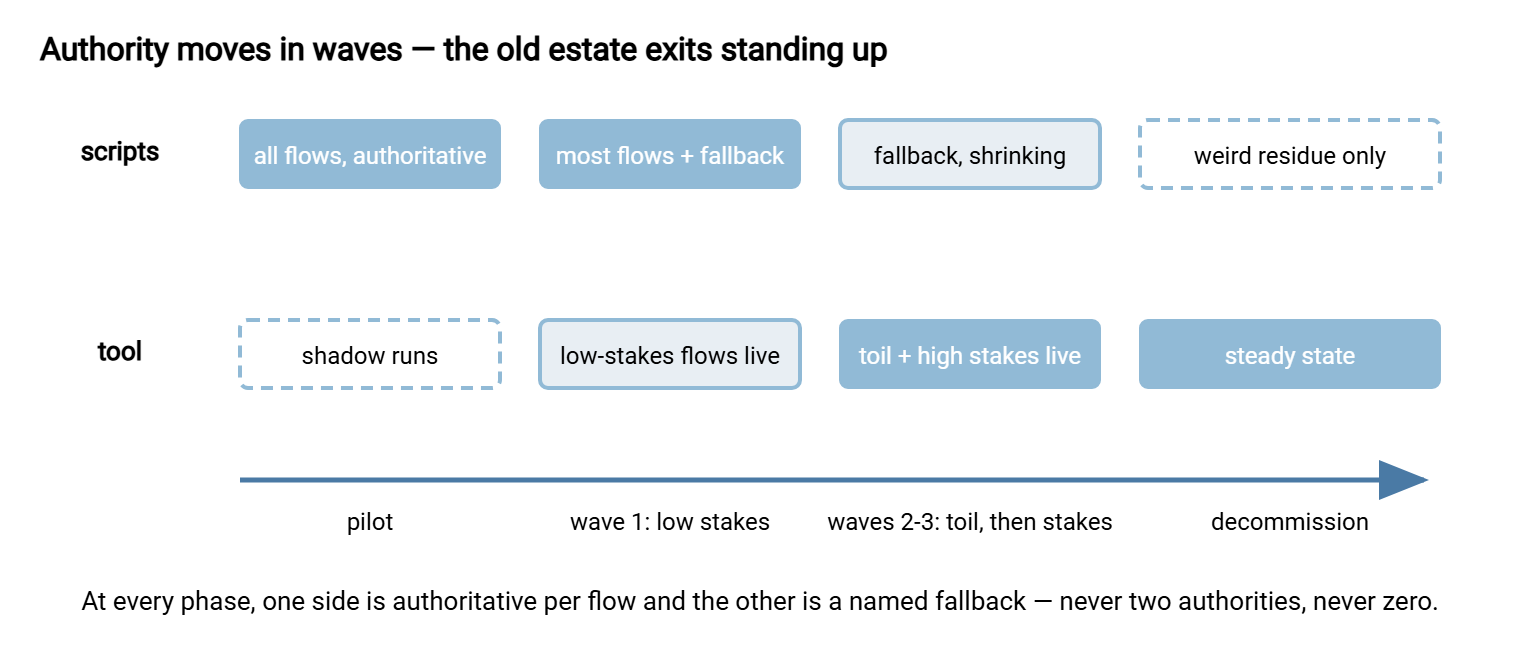
Wave one moves representative, low-stakes flows — internal reports, tolerant partners. Its purpose is not payback; it is learning the tool's habits where mistakes are cheap. Wave two moves the toil: the flows your ledger showed to be eating the hours. This is where the migration starts paying rent. Wave three moves the high-stakes flows last, each with a rehearsed rollback. The fallback script is tested against the live flow the week before cutover, not merely believed in. The mechanics are in change rollout and rollback. And a residue never moves at all: the genuinely weird flows where bespoke code wins on merit. Write that down as a decision, not an embarrassment.
Three rules span all waves. No flow migrates undocumented — write its one-page specification first (endpoints, schedule, transformations, failure behavior, evidence needs). The rebuild is checked against the spec, and the spec is what makes this migration your last archaeology dig. Every migrated flow keeps its script as a disabled, dated fallback for a fixed number of weeks. Then the script gets a deliberate decommission: credentials revoked, script archived with the spec, inventory updated. It is a ceremony, because estates rot through their leftovers, and a transition is the one chance to not create any. And the parallel period runs under real operational discipline — the scheduled-job hygiene you already owe your estate matters double while two systems share it. For sequencing at larger scale — many partners, many endpoints, cutover coordination — the migrating transfer workloads pillar covers the mechanics in depth. And if what you are really consolidating is sprawl — five servers, three script piles, nobody sure of the full list — start with the FTP sprawl and consolidation pillar, because consolidation changes the sequencing math.
Cutover day itself, per flow, is a fifteen-minute ceremony that deserves its own tiny script. Run in this order, because the order is what prevents the two classic day-one incidents. Announce the change window to anyone who watches the flow's output. Disable the script's schedule first (never let both authorities run one real cycle — duplicate deliveries embarrass you exactly once). Enable the tool's task. Watch one full live cycle end to end, comparing output names, sizes, and destinations against the spec. Deliberately confirm the failure alert path by forcing one dry failure if the flow's rhythm allows it. Date-stamp the fallback script and set its removal reminder. Update the inventory line — owner, home, cutover date — while still in the chair. The whole point of waves is that this ceremony stays boring. If cutover day is exciting, the pilot or the spec was skipped, and the correct move is backward, not faster. Recovery behavior deserves particular attention in the comparison, because it is where rebuilt flows most often differ silently from their originals. The properties to check are exactly the ones in designing for recovery.
One more path deserves naming because it removes the cliff entirely: the middle rung. Adoption does not have to mean replacing scripts wholesale. Automation tools expose command-line clients (our Sysax FTP Automation ships sysaxftp.exe) precisely so existing scripts can delegate the transfer step itself to the tool while keeping their surrounding logic. Script steps can run inside tool tasks for the inverse. Teams that take the middle rung migrate the riskiest layer — the protocol handling and retry — while their business logic stays exactly where it was. Some stay on that rung permanently, satisfied. Seams, not walls.
Direction Two: Tool to Scripts
The reverse migration is real, legitimate, and under-documented. It happens when a vendor is acquired and the product's trajectory turns, or when a price structure steps past what the estate justifies. It happens when flow count shrinks after a divestiture, or when a team has grown the engineering depth that makes the build position genuinely holdable. The build position's conditions checklist is the entry exam for this direction, and it should be passed on paper before a single flow moves. Enthusiasm is not an entry exam.
Here is a composite scenario, assembled from stories we have heard more than once. A team's automation product is acquired, the release cadence slows, support answers turn scripted, and the renewal arrives with a new tier structure. Nothing is broken — which is exactly the trap, because "nothing is broken" defers the decision until something is. The team that kept its exit contract has a different year than its neighbors. Flow specs already exist, and logs are already in its custody. The annual drill already priced a rebuild at a known number of days per flow. The team runs the worksheet, passes the conditions checklist, and walks — calmly, in waves, over two quarters. The team without the contract stays, not because staying won, but because leaving was never kept cheap enough to consider. The difference between those two teams was never engineering; it was seven contract items kept current.
The craft is symmetric, which is the quiet point of this whole article. Same pilot: scripts built beside the running tool, shadowing real flows against test endpoints, graded on pre-written criteria. Same waves: low stakes first, toil second, stakes last, tool tasks kept as disabled fallbacks. Same documentation rule, with one adaptation worth stealing: harvest the tool's discipline on the way out. Its uniform log format becomes the specification your script library's logging should meet. Its retry defaults become your retry library's defaults. Its task list IS the flow inventory, exported on day one. Teams that rebuild to the tool's operational standard keep most of what buying gave them. Teams that rebuild to their old habits rediscover, within a year, why they bought. Old habits migrate faster than flows do.
And one asymmetric warning: export everything evidentiary before the license lapses — transfer histories, activity logs, task definitions, the same set backing up transfer configuration tells you to keep anyway. Your retention obligations outlive your subscription, and auditors are unmoved by "that evidence stayed in a product we left." Exit with your paper trail or you have not exited; you have absconded.
Exit-Readiness, In Both Directions
Everything above assumed the door you need is open when you reach it. Doors do not stay open by themselves — lock-in, as the hidden-costs article noted, compounds quietly while unexamined. It has a build-side twin: the estate so entangled with one author's habits that leaving them is the unthinkable move. Exit-readiness is the discipline of keeping both doors cheap, and it costs a few hours a year against a trapped decade. Doors, like certificates, expire quietly.
Meridian Parts tested the exit before the entrance, which is rarer than it should be. Before the first wave moved, the team took one mid-complexity flow that had already been rebuilt in the trial. They rebuilt it back into a script from the tool's task definition alone, timing the work. It took a day and a half, most of it discovering that the spec had left out a rename. The spec was fixed, the number went into the contract as the baseline exit cost, and the migration went ahead with the door already measured. Three renewals later the drill still runs every year, and the number has moved twice. Both times, that was because a spec had drifted rather than because the tool had grown teeth. Nobody has used the door; knowing its width was the point.
The contract below is written for adoption day — either direction's adoption day — and it is deliberately short enough to actually keep. Sign it when you move in, and review it at every renewal alongside the cadence in ongoing vendor monitoring. No vendor, us included, will send a reminder for this one.
THE LOCK-IN-PREVENTION CONTRACT WITH YOURSELF
(signed the day any transfer home is adopted - tool or scripts)

 1. STANDARD PROTOCOLS ONLY at every partner boundary.
    Partners connect over SFTP/FTPS/HTTPS - never anything
    proprietary - so changing homes never means changing them.
 2. FLOW DEFINITIONS LIVE OUTSIDE THE HOME. Every flow has a
    one-page spec (what, when, where, transformations, failure
    behavior, evidence needs) in the inventory, written so a
    stranger could rebuild it in any home.
 3. EVIDENCE IN OUR CUSTODY. Logs and transfer histories are
    exported to storage we control on a schedule - retention
    must survive any vendor, license, or author.
 4. CREDENTIALS ARE OURS. Keys and accounts are issued,
    recorded, and rotatable by us - never existing only
    inside the home.
 5. THE ANNUAL EXIT DRILL. Once a year, rebuild one
    mid-complexity flow outside the current home (script one
    tool task, or task one script), time it, and file the
    number. That number is your real exit cost - watch its
    trend, not your assumptions.
 6. THE PARTNER REPOINTING LIST. A current list of who
    connects to what, with each partner's change lead time -
    the true calendar of any future move.
 7. RENEWAL REVIEW. At every license renewal (or yearly for
    scripts): re-read this contract, re-check items 1-6, and
    record what leaving would take today. Ten lines, dated.

Kept honestly, this contract makes every future build-vs-buy
decision cheap - which is the only state in which they get
made well.
Remember: the contract's items cost almost nothing on adoption day and become progressively unbuildable afterward. Nobody retrofits flow specs during a vendor dispute, and nobody exports logs from a product they lost access to. Exit-readiness is bought early or not at all.
Arriving Without Regret
Here is the regret-free transition, compressed. Authority moves only when earned in writing. Every move is small enough to reverse and every reversal is rehearsed, not assumed. The skeptic drives; the evidence trail never breaks. The door out of the new home is propped open on day one, by contract. None of it is glamorous. All of it is why some teams change transfer homes the way adults change houses — deliberately, with an inventory. Others produce the stories that open every article in this genre. Including this one, on a Monday at nine.
This closes the series where it began: build versus buy is a standing decision about which layers belong where, re-made as your facts change. The worksheet prices the facts; this article makes acting on them safe; and the contract above keeps the next decision as cheap as this one. However your estate is settled — built, bought, or seamed down the middle — may it be settled on evidence, and may the door always open from the inside.
Frequently Asked Questions
How long should the parallel period last?
Do we ever actually delete the old scripts?
What should happen when a pilot fails?
Is moving from a tool back to scripts admitting the purchase was a mistake?
How do we keep partners from noticing the transition at all?
What happens to our audit trail across the cutover?
From the Sysax team: we build secure file transfer software for Windows. Sysax Multi Server is an FTP, FTPS, SFTP, and HTTPS server. Sysax FTP Automation handles scheduled, scripted transfers. Free trials are on the download page.