
The Exceptions Process: Bending Without Breaking
The exception was for one project, one partner, ninety days. The project ended in the autumn, the partner has since been acquired, and the exception is in its third year. The account it created still logs in every Monday, and the manager who signed it works somewhere else now. That is one ending. The beginning is always the same: somewhere in the first week of your new file transfer policy's life, reality files an objection. A partner's ordering system speaks only one ancient protocol. A customer's procurement portal demands uploads through their tool, not yours. A survey crew is headed somewhere with no connectivity at all, and the data has to come back somehow. None of these people are trying to undermine your policy. They are holding a legitimate business need that the approved list, for all its care, does not serve.
What happens next depends on whether the policy has an exceptions process, and on whether that process has an end. If it does, the need becomes a request: visible, assessed, approved with guardrails, and written down. If it does not, the need becomes a workaround: invisible, unassessed, and permanent. A policy without an escape valve does not produce zero exceptions — it produces unrecorded ones. This article, part of our Writing a File Transfer Policy series, is about building that valve properly. It covers the request path, the time-boxing, the compensating controls, and the register that turns bent rules into managed risk.
Why "No Exceptions" Fails in a Week
Zero-exception policies come from an understandable instinct: exceptions feel like erosion, and refusing to allow any feels like strength. But walk through what the strict version actually does when it meets the standard cast of characters:
- The legacy partner. Their side cannot do key-based login, or speaks only an old protocol, and their IT queue for changing that is measured in seasons. Your policy's opinion does not change their software.
- The counterparty with power. A big customer or a regulator instructs you to use their delivery portal. "Our policy forbids it" is not an answer your sales director will deliver for you.
- The disconnected site. Field work, factory floors, air-gapped environments: places where "use the transfer server" is a sentence without a network to run on.
- The outlier payload. A dataset so large, or a deadline so tight, that the normal path physically cannot carry it in time.
Faced with a flat "no," each of these needs gets met anyway — quietly. The partner's feed moves to someone's personal account. The huge file goes through a consumer sharing site over a home connection. And the policy's authority dies in the process, not because people are lawless but because the document asked for the impossible and lost. The real choice was never between exceptions and no exceptions. It is between exceptions you can see and exceptions you cannot. An approved exception is a controlled deviation: bounded in time, wrapped in controls, written in a register. A workaround is the same deviation with all the safeguards removed.
What Counts as an Exception — and What Is Really a Policy Gap
An exception is a documented, time-limited permission for a named person or flow to deviate from the policy in a specific way. It has compensating controls attached. Every word of that definition earns its place. It is documented (it exists on paper, not in a hallway agreement) and time-limited (it expires on its own). It is named (it covers this flow, not "marketing generally") and specific (this method, this data, this counterparty). It comes with controls (the risk is reduced, not just accepted).
Not everything that arrives as an exception request should leave as one. Watch for two impostors. The first is the policy gap. When the third different team asks to do essentially the same unapproved thing, the policy is missing an approved method. The fix is to build one and add the row — the process from our approved and forbidden methods article. Do that rather than keep stacking parallel exceptions. Exceptions are for the rare; the frequent belongs in the policy. The second impostor is the emergency: an active incident where data must move right now to contain damage. Incident response has its own authority and its own paperwork. Do not make responders queue behind the exceptions mailbox. Do not let "it was an emergency" become a retroactive label for ordinary impatience. A one-line rule works: real emergencies are declared to the incident process, and everything else can wait one business day. Told it can wait a business day, a surprising share of emergencies agree.
Designing the Request Path: Make Asking Cheaper Than Hiding
The exceptions process has a competitor, and it is not "compliance." It is the workaround: three minutes, no questions, no waiting. Every design decision in your request path should be measured against that alternative, because the requester is measuring, whether consciously or not. The goal is a path so cheap that asking is easier than hiding.
The diagram below shows the whole path — five stations from request to retirement. Note the early exit: a healthy share of requests end at triage, when it turns out an approved method can serve the need after all.
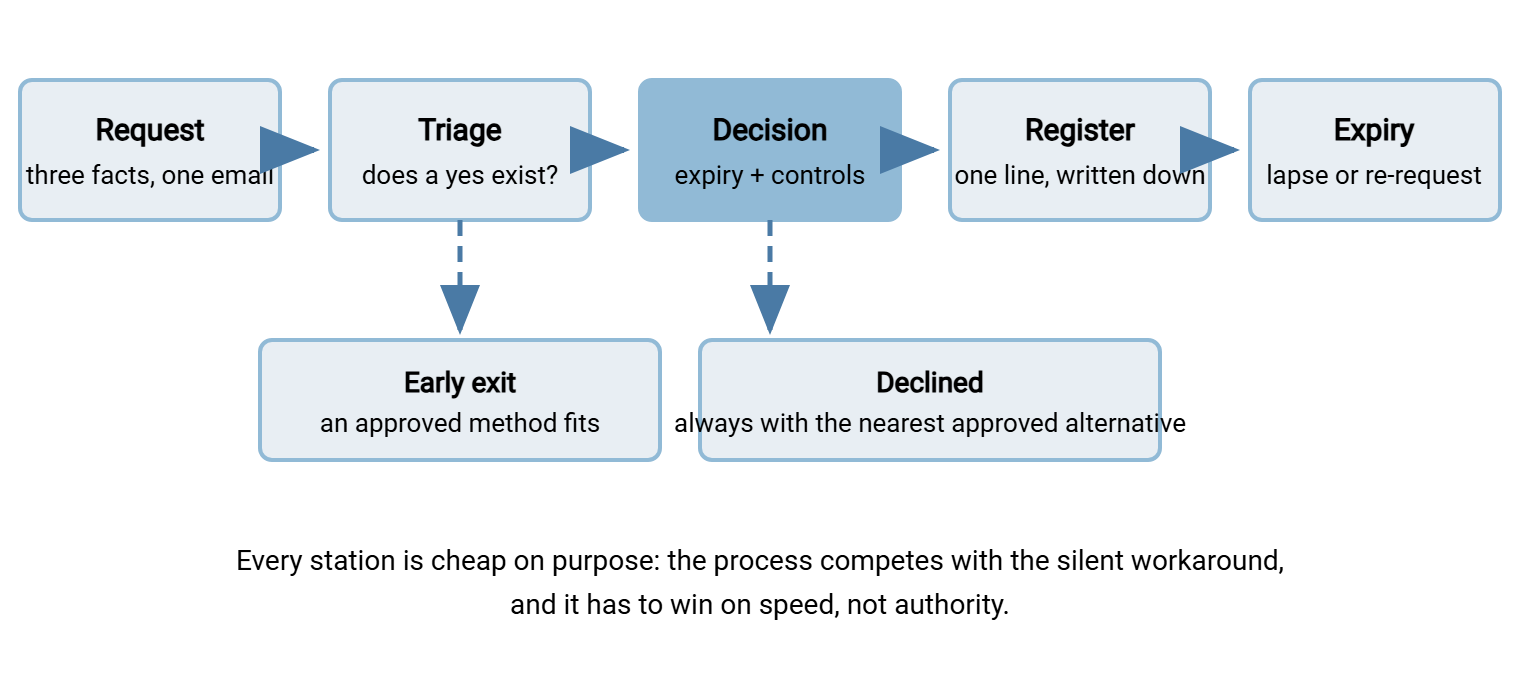
Concretely, the path needs four properties. One front door: a single mailbox or form, named in the policy, so nobody has to know the org chart to ask. Three questions: what needs to move and how sensitive is it, between whom, and why the approved methods do not fit. If your form takes longer to complete than the workaround takes to execute, you have designed a workaround generator. One decider with a deputy: a named manager or data owner approves. Accepting risk on the organization's behalf is a management act, not a technical one. The admin's role is to advise on risk and design the controls, and it protects you to keep those roles straight. The deputy matters because a process that stalls when one person is on leave teaches everyone its real priority. A priced wait: the policy promises an answer within one business day, and the process delivers, because the promise is the whole pitch. The triage step is where your knowledge earns its keep. In many requests the need can be served by an approved method the requester did not know about — a temporary account, a scheduled job. The best possible outcome of an exception request is discovering no exception is needed. The quick risk look for the rest is a two-minute version of the thinking in our transfer risk assessment guide. It asks what data, how sensitive, what could go wrong on this path.
A request form that fits in one email and still captures everything the decision and the register need looks like this:
EXCEPTION REQUEST — transfer policy
Requester / department:
Date needed by:
What is being transferred (and how sensitive):
From where, to where (people and systems):
Method requested:
Why the approved methods don't fit:
How long is this needed (one-off / until date):

--- completed by approver ---
Decision (approved / declined / served by approved method):
Compensating controls required:
Expires on:
Approved by / date:
Register entry number:
The decline is a service too, and its quality decides whether people keep asking. A good decline arrives inside the same one-day promise and explains the risk in one plain sentence. It always names the nearest approved way to get the underlying job done — even if that way is slower or partial. A requester who receives a respectful, useful no will file another request next quarter. A requester who receives a lecture, or silence, will not ask again. They will remember that asking was the mistake, and the process loses exactly the visibility it exists to create. That is the department of no in embryo; why transfer policies get ignored traces how it grows up.
Time-Boxing: Every Exception Carries an Expiry
The single most protective sentence in your exceptions section is this one: every exception expires. An exception without an end date is not an exception — it is an unversioned amendment to your policy, made without anyone deciding to amend it. Time-boxing is what keeps the bending from becoming the new shape. Every exception, including the one for the partner who is "basically internal."
Here are sensible defaults, in words your policy can use. A one-off transfer gets an exception measured in days — a week or two, long enough to survive a slipped deadline. A partner-capability problem gets ninety days, which is honest about how long the other side's fixes take while still forcing a check-in. Nothing gets more than a year, ever, and reaching a year should require a renewal conversation, not a rubber stamp. Renewal is deliberately a fresh request — cheap to file if nothing changed, but a real decision point. Someone asks the only question that matters: is the reason this exception exists still true? Expiry dates are also what make the register self-cleaning; without them it becomes an archaeology site. I have inherited one; its oldest entry named a partner that had since been acquired, renamed, and acquired again.
Remember: "temporary" is a claim, and an expiry date is the only thing that makes it true. If your organization remembers an exception as permanent, the policy has quietly changed — and nobody signed the change.
Compensating Controls: How to Say Yes Safely
A compensating control is a safeguard added to make up for the protection the normal rules would have provided. It is the reason an approved exception is a managed risk rather than a hole. When you cannot have the protection you wanted, you take the protections you can get. In transfer exceptions they come from a short, reusable menu:
- Shrink the scope. The exception covers one flow, one counterparty, one folder — never a person's job in general. A dedicated account with access to a single directory turns "they can use the old protocol" into "they can use it to reach exactly one place."
- Encrypt the payload itself. If the channel is weaker than you would like, make the file self-protecting. OpenPGP encryption before it leaves means the data stays sealed regardless of what carries it. The pattern is described in encrypt-before-send workflows. If the flow is automated, Sysax FTP Automation can apply OpenPGP encryption as part of the scheduled job. That way, the control does not depend on a human remembering it.
- Fence the endpoint. Confine the deviation to a known corner of the network. On a server like Sysax Multi Server, the account for an excepted partner can be limited with IP allow and block rules to their known addresses. It can be given its own credentials and folder, and every session it makes lands in the activity log. So the one flow you are least comfortable with becomes, ironically, your most-watched.
- Raise the visibility. Excepted flows get their logs looked at — a weekly skim, or notifications on activity — precisely because they are the flows the normal rules do not cover.
- Shorten everything. Temporary accounts created for the exception and removed at its expiry; files deleted from staging as soon as delivery is confirmed.
A worked example ties it together. The machine-shop partner from your discovery exercise can only fetch drawings with a password over FTPS — no keys, no modern client. The exception: approved for ninety days. The controls include a dedicated account, locked to the partner's IP addresses, reaching one outbound folder that contains only current drawings. They also include log review weekly and a calendar entry to revisit. The decline that never happened matters too. Had the request been "let us keep emailing drawings from personal accounts," the answer would be no — with the FTPS arrangement offered as the alternative. Declines should always ship with the nearest yes.
The Exception Register
The exception register is where the whole process pays for itself. It has one line per exception, in a shared list that IT and management can both see. It does not need software — a spreadsheet is fine. It needs these columns:
EXCEPTION REGISTER — columns
ID        short reference number
GRANTED   date approved
WHO       requester and department
WHAT      data and flow, one line
METHOD    the deviation (what rule is bent, and how)
WHY       reason approved methods don't fit
CONTROLS  compensating controls in force
EXPIRES   the date it dies
OWNER     approver who accepted the risk
STATUS    active / expired / closed / renewed (with new ID)
Keep it somewhere deliberately unclever: a shared location that both IT and the approving managers can read, never an admin's personal folder. A register only one person can find is a register the organization does not have. File the original request email and the approval alongside each entry, named by its ID, so the one-line summary always has its paperwork within reach.
Two audiences make the register worth its upkeep. The first is future-you. Six months on, when someone asks why a strange account exists on the transfer server, the register answers in one lookup instead of one investigation. The second is the auditor. Every serious review of your transfer controls will probe how deviations are handled, and organizations fall into two piles. Some shuffle and say "well, sometimes, informally..." Others produce a register showing each deviation was assessed, controlled, bounded, and signed. The register is the difference between we bend the rules and we manage risk. It slots directly into the evidence pack described in our guide to audit-ready reporting.
Review Before They Fossilize
Exceptions age badly when unwatched. The partner fixes their system but nobody tells you; the ninety-day arrangement enters its second year of quiet renewal; the "one-off" account is still there, still enabled. So the register gets read on a schedule — quarterly is right for most organizations, and the reading takes minutes, not meetings. You are looking for three signals:
- Pile-ups. Several exceptions telling the same story — different requesters, same underlying need. That is a policy gap wearing exception costumes: build the approved method, add the row to the policy, and retire the whole pile at once.
- Long-livers. Anything on its second renewal deserves a project, not another rubber stamp. If the blocker is a partner who has not migrated, that becomes a dated migration conversation. The templates in partner communications are built for exactly this. In that case, the exception's final expiry is the deadline that makes the conversation real.
- Zombies. Expired on paper, active in practice: the account still enabled, the flow still flowing. Every zombie is a small enforcement failure. Finding them here — cheaply, internally, quarterly — is vastly better than an auditor or an incident finding them for you. Closing the loop between expiry dates and actual shutoffs is part of the maintenance rhythm covered in enforcing and updating your policy.
Bluewater Bank found one of its zombies the slow way. A courier's upload account had been granted a ninety-day exception while the courier "finished moving to SFTP." The exception was renewed twice by reply-all, and then forgotten when the approving manager moved branches. The courier contract ended; the account did not. It sat enabled for another year until an auditor, sampling accounts, asked what it was for. The administrator spent an afternoon reconstructing the approval trail from three mailboxes. Nothing had used the account, which was the only fortunate part. The register moved to a shared folder the following week, and the expiry column acquired a calendar reminder.
Gotcha: the review only works if expiry has teeth. When an exception lapses, its account gets disabled and its requester gets a heads-up a week in advance. That takes automation or a recurring calendar entry, not memory. A register full of expired-but-active rows is a policy with a hole in it, nicely documented.
The Valve That Keeps the Boiler Whole
The summary fits in a few sentences. Your policy will meet needs it cannot serve; that is a certainty, not a failure. Give those needs a front door that is cheaper than hiding: three questions, one decider with a deputy, an answer within one business day. Approve with an expiry and compensating controls, decline with the nearest alternative, and write every outcome into a register that management signs and auditors respect. Read the register quarterly, and let it tell you which exceptions are really policy gaps, which need a migration project, and which quietly refused to die. The ninety-day one in its third year, for a start.
Done this way, exceptions stop being erosion and become intelligence — the policy's way of learning where reality disagrees with it. One natural companion read is approved and forbidden methods, since the best exception outcome is a new approved row. The other is enforcing and updating the policy. There, the register becomes one of your main instruments for keeping the document matched to the organization it governs.
Frequently Asked Questions
Who should approve exceptions — IT or management?
How fast should exception requests be answered?
What happens when an executive asks for an exception?
Does an expired exception automatically become a violation?
How many exceptions are too many?
From the Sysax team: we build secure file transfer software for Windows. Sysax Multi Server is an FTP, FTPS, SFTP, and HTTPS server. Sysax FTP Automation handles scheduled, scripted transfers. Free trials are on the download page.