
How Transfer Sprawl Happens to Good Organizations
"Three. Maybe four." That is what an administrator says when you ask how many file transfer servers the organization runs, and it is said with real confidence. Then someone counts, for an audit, a datacenter move, a security review, and the number comes back seventeen. There are two in the DMZ and one under a desk in Engineering. There are four in a cloud subscription paid on a team credit card, and a vendor appliance in a branch office. There is an old box in a rack that nobody has logged into for years but that a partner still uploads to every night. Nobody decided to run seventeen transfer servers. Nobody would. And yet there they are, each one running, each one moving somebody's files, each one quietly certain it is the important one.
This is transfer sprawl: an estate of transfer servers, scripts, and scheduled jobs that grew by accretion instead of design. This article, the first in our Sprawl Consolidation series, explains how sprawl happens to competent, well-run organizations. It explains what sprawl quietly costs and why it persists once it exists. The mechanism matters because the forces that grew your sprawl are still active today, and any consolidation that ignores them will be undone by them. Sprawl is patient. The rest of the series is the cure; this is the diagnosis.
Sprawl Is an Estate Problem, Not a Protocol Problem
Two adjacent problems get conflated constantly, so the scope comes first. Our Retiring Plain FTP series addresses a protocol problem: plain FTP moves credentials and data in cleartext. The fix is to replace it with encrypted protocols wherever it runs. This series addresses an estate problem: too many servers, scripts, and scheduled tasks doing transfer work, regardless of what protocols they speak. An estate of nine SFTP servers is fully encrypted and still sprawl. The two programs overlap, since the discovery techniques are nearly identical and one consolidation often absorbs a protocol retirement along the way. But the goals differ. Protocol retirement ends when cleartext is gone. Consolidation ends when the estate is small enough to know, secure, and operate. You can need either, or both; most organizations that need one need both.
Nobody Decides to Sprawl
Sprawl is not a record of bad decisions. Almost every server in a sprawled estate was a reasonable decision when it was made. A project needed a file drop by Friday, and standing up a small server was faster than negotiating space on the shared one. A partner insisted on their own endpoint with their own credentials. An acquired company arrived with its own transfer stack, and unpicking it was nobody's priority during integration. A departmental admin solved a departmental problem with departmental hardware, exactly as their job description implied they should.
Each decision was locally rational. The global result — an estate no one can enumerate, secure, or afford to touch — was chosen by no one. That is why sprawl happens to good organizations: it does not require negligence. It only requires time and the absence of a single owner for the question "how many transfer endpoints should we have?" In most organizations, no such owner exists. Servers have owners; scripts have authors; the estate has nobody. Sprawl is what an unowned estate does by default. It does not need a decision, only an absence.
The Six Forces That Grow Sprawl
Watch enough estates grow and the same six forces appear every time. They are worth naming individually, because each one needs a different countermeasure when you get to preventing re-sprawl at the end of this program:
| Force | How it adds to the estate | Typical artifact |
|---|---|---|
| Deadline pressure | Standing up a new server is faster than requesting space on an existing one | A "temporary" project server, still running years later |
| Acquisitions and mergers | Each acquired company arrives with a full transfer stack of its own | A parallel estate with different naming, accounts, and habits |
| Departmental autonomy | Teams with budget and admin rights solve their own problems locally | Engineering's box, Finance's box, Marketing's agency-upload box |
| Partner and vendor demands | "Our system only sends to a dedicated endpoint" ends the discussion | One endpoint per demanding partner; vendor appliances with transfer roles |
| Personal tooling | Individuals script their own transfers on whatever machine is handy | Scheduled tasks on workstations; scripts under one person's account |
| Fear of touching what works | Old endpoints are never retired because nobody is sure what depends on them | The legacy server kept alive "just in case," accumulating one more year |
Notice that the last force is different in kind from the first five. The first five add endpoints; the last one prevents removal. Sprawl is a ratchet: additions are easy, cheap, and locally justified, while removals are risky, unrewarded, and globally justified at best. Any system with easy additions and hard removals grows without limit. Any garage will confirm this. That asymmetry, more than any single decision, is the engine of sprawl, and reversing it is the entire strategic content of a consolidation program.
One Estate, Year by Year
Here is how the forces compound in practice, compressed into one composite story that will feel familiar. An organization starts with one properly run transfer server. A rush project adds a second "for now." An acquisition brings three more, plus a folder of scripts nobody reads. A big partner demands a dedicated endpoint; a vendor's appliance turns out to quietly run its own FTP service. Somewhere in there, a developer spins up a cloud VM to move build artifacts, pays for it on a team card, and changes jobs. No single year looks alarming. The sum is an estate.
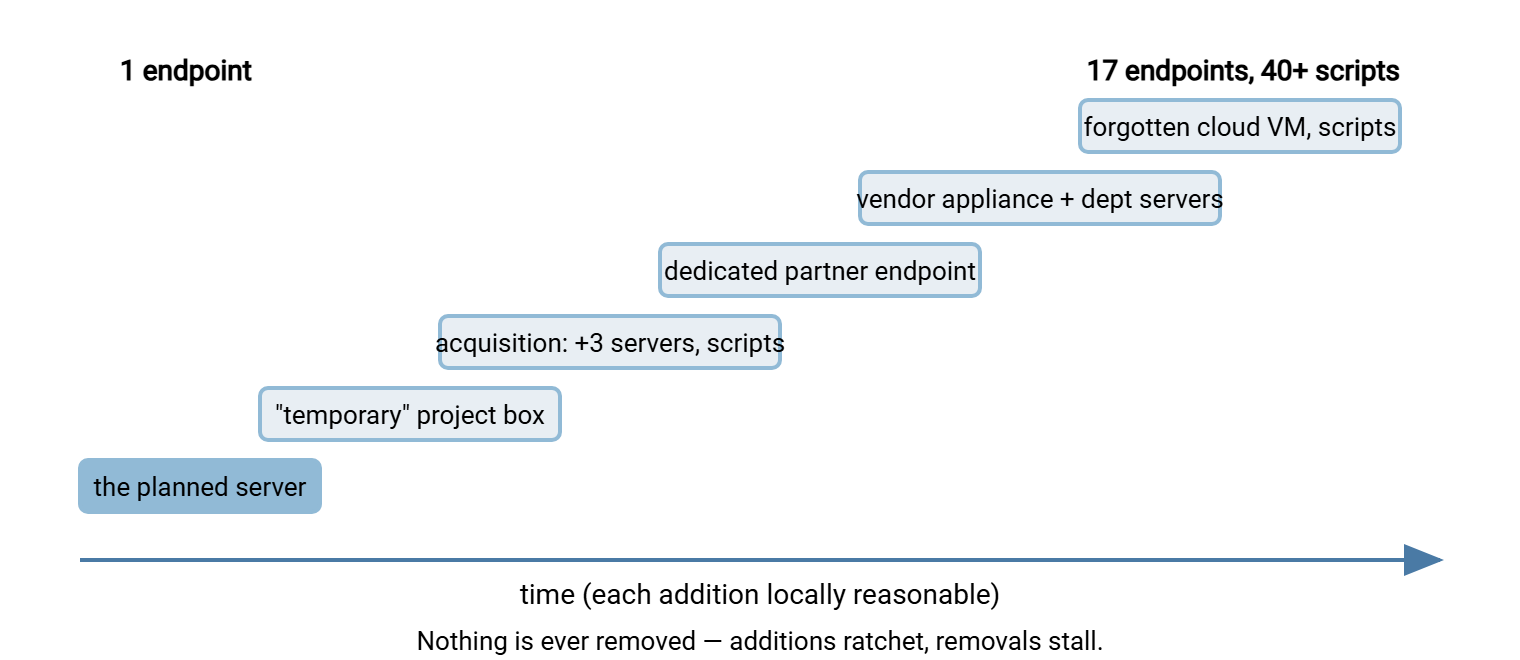
The compounding detail most people miss: every added server breeds added scripts. Each new endpoint acquires its own feeders — scheduled jobs pushing files in, pulling files out, cleaning up, retrying. A modest estate of seventeen servers typically carries several dozen scheduled transfer jobs spread across task schedulers, cron tables, and application configs. Each hard-codes a hostname somewhere. The scripts are why estates resist cleanup so fiercely: turning off a server means finding everything that talks to it first. The scripts are far better hidden than the servers. A server at least has a power light. Our automation inventory article calls these accumulated jobs automation debt, and sprawl is where that debt and infrastructure sprawl meet and multiply.
What a First Census Actually Finds
When an organization finally counts, the census table tends to look like this composite. The full sweep is the subject of the next article. This composite is drawn from what such sweeps reliably turn up:
| Endpoint | What it is | Protocols | Owner | Notes |
|---|---|---|---|---|
| transfer.example.com | The official server | SFTP, FTPS | IT | Documented, patched, monitored — the only one |
| ftp-legacy-03.example.com | Rack server, pre-dates current staff | FTP | Unknown | A partner uploads invoices nightly; admin password not on record |
| sftp-eng-01.example.com | Engineering's build-artifact drop | SFTP | Engineering | Well run, invisible to IT, unpatched for two quarters |
| files-acme.example.com | Endpoint demanded by one partner | FTPS | Sales ops | One flow, one partner, an entire server |
| Branch office appliance | Vendor device with a transfer role | FTP, proprietary | Operations | Runs an FTP service nobody configured on purpose |
| sftp-tmp-02 (cloud VM) | Developer's artifact mover | SFTP | Author left | Paid on a team card; keys still valid; still moving files |
| finance-drop share + jobs | Old server doubling as a drop zone | SMB, FTP | Finance | Feeds statements_YYYYMMDD.csv to three downstream scripts |
| Workstation under a desk | Scheduled tasks on a PC | SFTP out | One person | Runs the nightly partner send; off when the PC is off |
Read the owner column again. That is the census's real finding: not seventeen servers, but four distinct ownership situations. They are owned and run properly, owned but invisible, owned by a department without security involvement, and owned by nobody at all. The estate's risk concentrates in the last two categories, and the fix differs per category. That is why the triage article treats ownership as a first-class axis alongside usage and risk.
Northgate Retail's answer on the audit questionnaire was four. Before returning it, the security team ran a listener scan across the store network and found eleven. They included an FTP service on a label-printing appliance that had shipped that way. They included a scheduled task on a regional manager's PC that sent the weekly stock file to a distributor. Every one of the eleven had a reason, and most had a person who could explain it. Nobody was in trouble; the questionnaire was amended to read eleven, with a footnote that said "so far." The lesson Northgate kept was the one this whole series rests on: the number you know is the number you have counted, and only that.
What Sprawl Actually Costs
Sprawl's costs are easy to underestimate because they are distributed — a little everywhere, a lot nowhere. Added up, they fund the consolidation program several times over.
- Attack surface. Every listening endpoint is a door: an authentication surface to brute-force, a software version to exploit, a credential set to leak. Seventeen servers is seventeen patch schedules, seventeen certificate expiries, seventeen sets of accounts to review. In a sprawled estate, most of them get none of that attention. Our threat-modeling series makes the general case in mapping the transfer attack surface. Sprawl is that article's worst-case illustration, because surface you do not know you have is surface you cannot defend.
- Operational drag. Each endpoint carries a quiet tax: backups, monitoring, storage, renewals, the half-day lost every time something odd happens on a box nobody understands. None of these line items looks big; the estate-wide sum is a part-time job nobody was hired to do.
- Audit pain. "Show us every system that transfers files, its controls, and its access reviews" is a routine audit request. Against one platform it is an afternoon. Against sprawl it is weeks of archaeology, and the findings write themselves — unowned systems, unreviewed access, logs that exist nowhere or everywhere.
- Incident ambiguity. When data may have left the building, the first question is "through what?" A sprawled estate cannot answer it. The investigation has to enumerate the estate first — during an incident, at the worst possible hour, discovering servers for the first time while responders wait.
- Duplicate spend. Sprawl pays for the same capability many times over. There are parallel hardware or VM subscriptions, overlapping maintenance renewals, and certificates for endpoints doing one job each. There is storage bought in seventeen small expensive slices instead of one planned one. Procurement rarely sees the duplication because the line items live in different budgets. That is exactly why spend records become a discovery source in the next article.
- Knowledge risk. Every undocumented endpoint is held together by the memory of whoever set it up. People leave. The estate stays. The gap between those two sentences is where the nightly invoice upload to ftp-legacy-03 lives.
Why It Persists Once It Exists
If sprawl is expensive, why does it survive? Because at every decision point, the incentives defend it. Retiring an old endpoint is all risk and no reward for the person doing it. If the shutdown goes cleanly, nothing visible happened. If it breaks a hidden flow, they own an incident. Leaving it running costs nothing attributable. Multiply that asymmetry across every server and every year and you get the standing answer to "should we clean this up?" — someday. I have watched a retirement ticket turn three, unassigned and in good health.
The other preservative is fragmented visibility. No one person sees the whole estate, so no one feels its full weight. Each owner sees one or two reasonable servers; only the sum is unreasonable, and the sum is invisible until someone builds the register. That is why consolidation programs start with discovery rather than with architecture. The register is what converts sprawl from a background condition into a decision an organization can actually make. It is also why the case for consolidation is best made with the census table above rather than with generalities. Counted, named, and priced, the estate argues against itself.
There is an accounting asymmetry at work too. Sprawl's costs are diffuse and unbudgeted — a patch cycle here, an audit scramble there. Consolidation's costs are concentrated and visible: a project, a platform, named people for a season. Organizations are structurally better at rejecting one visible cost than at noticing a hundred invisible ones. So the diffuse option wins by default year after year. What finally breaks the pattern is usually an external forcing event. It might be an audit finding that names specific unowned servers or an incident that took days longer because nobody could enumerate the estate. It might be a datacenter move or platform end-of-support that would otherwise mean rebuilding the sprawl piece by piece. If one of those events is on your horizon, it is not an obstacle to consolidation. It is the sponsor you have been waiting for. In that case, the program should be scheduled to ride it. Nothing funds a cleanup like a finding with a hostname in it.
What Consolidation Looks Like
The destination is not "one of everything forever" — it is few enough to know. That means a deliberately small set of transfer platforms, each owned, documented, logged, and defended, absorbing the work the sprawl was doing. For most Windows-centered organizations that means one consolidated server platform for hosted flows plus one scheduler for outbound automation. A multi-protocol server such as Sysax Multi Server illustrates why consolidation became practical. One Windows service can host many isolated tenant areas with per-account permissions. It can speak FTP, FTPS, SFTP, and HTTPS at once so both legacy and modern counterparts land on the same box. It can log every session to file and database. The protocol breadth matters strategically — it removes the classic excuse for keeping a separate legacy server around "because the old partner can only do FTPS." The scripts you keep get the same treatment on the automation side, re-platformed into a scheduler like Sysax FTP Automation instead of scattered across personal task schedulers. Yours may be a different platform. The properties — multi-tenant isolation, protocol breadth, central logging, one owner — are the non-negotiables. And the target-design article treats them in full.
The program that gets you there has five movements, one per remaining article in this series. First, discover every server, script, and task. Then triage the findings into keep, merge, and retire. Design the target. Execute the moves in waves without breaking flows. Then hold the line so the estate stays consolidated. None of the movements is exotic. All of them are discipline.
Remember: the forces that grew your sprawl — deadlines, acquisitions, autonomy, partner demands, personal tooling, fear of removal — do not retire when the project ends. A consolidation that only removes servers, without changing the incentives that added them, is buying a few quiet years before the next census finds seventeen again.
The Sprawl Smell Test
A quick self-assessment closes the diagnosis. Score one point for each statement that is true of your organization today. Be honest, and ask a veteran colleague to score it independently. The two scores will differ, and the higher one is right:
THE SPRAWL SMELL TEST — one point per true statement

[ ] Nobody can state the number of transfer endpoints without counting
[ ] A transfer server exists whose admin credentials are not on record
[ ] At least one production flow runs from a workstation or desk-side box
[ ] A partner still connects to an endpoint you no longer advertise
[ ] Two teams operate separate servers that do essentially the same job
[ ] A firewall rule allows transfer traffic to a host nobody can name
[ ] A departed employee's account still runs a scheduled transfer job
[ ] "What breaks if we turn it off?" has blocked a retirement for a year

Score 0-1: tidy estate — protect it (see preventing re-sprawl)
Score 2-4: sprawl is forming — run the discovery sweep this quarter
Score 5+:  you are the organization this series is written for
Whatever you scored, the next step is the same, because every path through this problem runs through knowing what you have. Discovering every transfer server, script, and task is the sweep that builds the register the whole program stands on. It is where the archaeology gets genuinely interesting. Sprawl had years to settle in. Now it is your turn to be patient.
Frequently Asked Questions
Is transfer sprawl a sign of bad IT management?
How many transfer servers is too many?
Is consolidation the same project as retiring plain FTP?
Can a small organization really have sprawl?
Does moving everything to the cloud fix sprawl?
Where should we start if this article described us?
From the Sysax team: we build secure file transfer software for Windows. Sysax Multi Server is an FTP, FTPS, SFTP, and HTTPS server. Sysax FTP Automation handles scheduled, scripted transfers. Free trials are on the download page.