
Data Sovereignty Explained for File Transfer Admins
"Where does the payroll file go after the job runs?" I asked that once and got "to the processor," which was true and not an answer. The processor's endpoint is a server in a rack in a building in a country. That country has its own laws about the data on its soil, its own courts, and its own ideas about privacy. The log says the transfer finished cleanly, not that a copy of your most sensitive employee data now rests under a different set of laws. That quiet side effect is what people mean when they say data sovereignty.
Sovereignty, residency, localization: three words used interchangeably in slide decks and compliance meetings, and wrongly about as often. This article pins them down: what each means, how they differ, and why one file can answer to two countries' rules at once. It explains why the administrator whose scheduled jobs physically move the bytes is where the theory turns into daily practice. It is the foundation article of our Cross-Border Transfers and Data Sovereignty series. Nothing in it requires a legal background. (It does require knowing where your servers are, which is the harder qualification.)
Data Lives Somewhere, and Somewhere Has Laws
No data is ever placeless, and everything else follows from that. Every byte your organization stores or sends ends up as magnetized regions on a disk or charge in a memory cell. All of that is on physical hardware in a rack, in a building, in a country. When you upload a file "to the cloud," you are really copying it to a computer in a specific place. You may not know which place, but there is one, and it has a postal code.
Places come with laws. Think of a filing cabinet of paper personnel records standing in an office in Germany. Nobody finds it strange that German law governs that cabinet. German privacy rules protect the records, and German courts can order them produced. German authorities have whatever inspection powers German law grants them. Ship the cabinet to an office in Singapore and the answers change — not because the paper changed, but because the cabinet now stands somewhere else.
Data on a server works the same way. Data sovereignty is the principle that data is subject to the laws and governmental powers of the jurisdiction where it physically sits. A jurisdiction is simply a territory with its own legal authority — usually a country. Sometimes it is a group of countries acting as a bloc. Sometimes it is a state or province adding its own layer on top. Whoever has legal authority over the ground under the server has a claim on the data sitting on it.
For an administrator, sovereignty shows up as three practical consequences. First, protection: the privacy and security rules of the hosting country apply to data resting there, whatever those rules are — strong, weak, or absent. Second, compulsion: the hosting country's courts and authorities can, under their own procedures, order data on their soil to be produced or preserved. Third, obligation: whoever operates the server — you, or a provider acting for you — can be legally required to do things with the data. Those may be things that nobody in your organization chose. None of this is sinister; it is just what "laws apply where things are" means when the things are files.
Residency, Sovereignty, Localization: Three Ideas, Not One
The three big words describe three genuinely different things, and conversations go wrong when they blur.
Data residency is a fact: where the data is actually stored. "Our transfer server is in our Frankfurt data center; the partner's endpoint is in Toronto" is a statement about residency. Residency is often also a choice — you decide which building hosts the server, or which region you select from a provider's menu. It answers the question where is it?
Data sovereignty is a consequence: because the data resides in a place, that place's laws and authorities apply to it. Sovereignty answers the question so what — whose rules govern it there? You do not configure sovereignty; it attaches automatically to whatever residency you created.
Data localization is a requirement: a law or contract that says certain data must remain within particular borders. Sometimes it is absolute, sometimes it has narrow exit conditions, and sometimes it is a duty to keep a local copy. Localization answers the question where must it stay? We give localization a full article of its own in Data Localization: When Data Must Stay Home.
A one-line memory aid: residency is the is, sovereignty is the so what, and localization is the must. The table below puts the three side by side.
| Term | What kind of thing it is | Question it answers | Where an admin meets it |
|---|---|---|---|
| Data residency | A fact (and usually a choice) | Where is the data stored? | Server placement, region menus, partner endpoint locations |
| Data sovereignty | A legal consequence of residency | Whose laws and authorities govern it there? | Vendor questionnaires, risk reviews, "who can demand our data?" |
| Data localization | A requirement imposed by law or contract | Where must the data stay? | "This data may not leave the country" instructions from legal |
Only one of the three is fully in your hands. You control residency — where you put things. Sovereignty follows from residency automatically; localization is imposed from outside. That is why residency decisions, which look like mundane infrastructure choices, carry so much weight. A region picked from a dropdown in a hurry is a legal position for as long as the server runs.
The Laws of Where It Came From Can Follow It
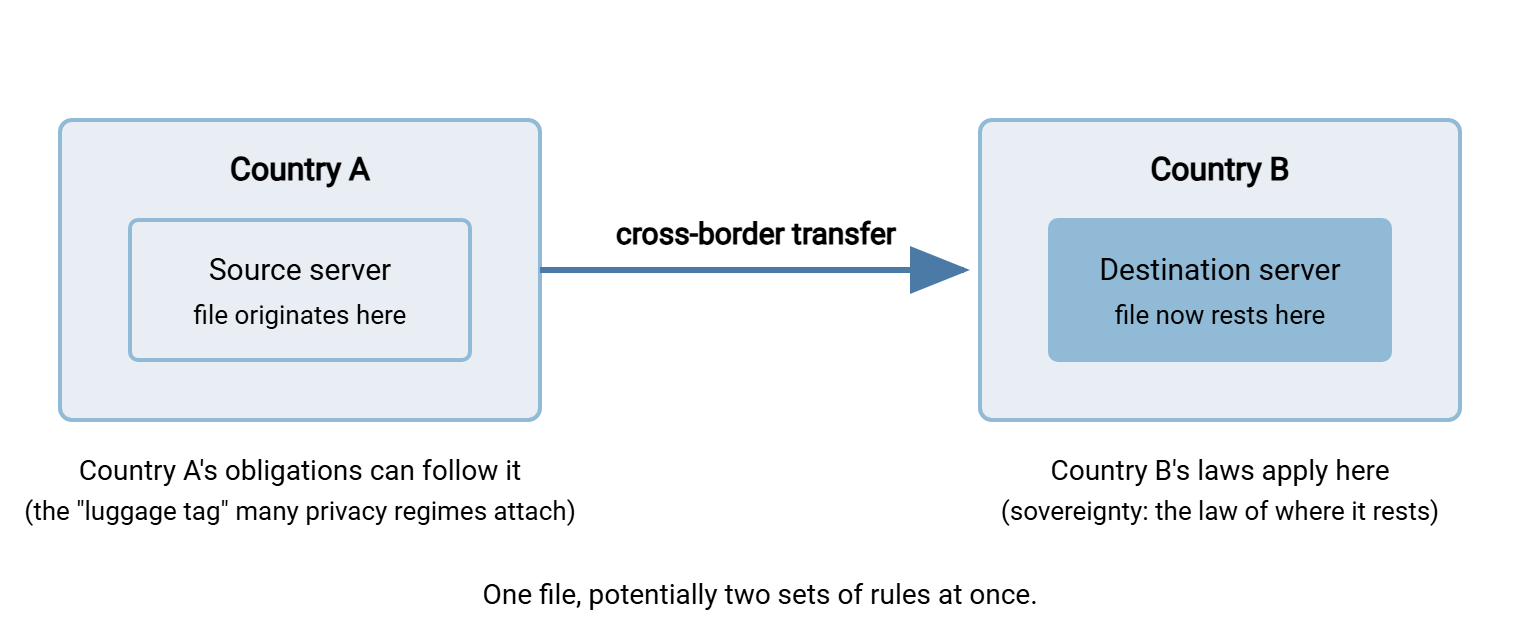
Sovereignty is half the story; the other half generates most of the real-world work. Many privacy regimes attach obligations to data about their own residents, and those obligations do not evaporate when the data leaves. They travel with it, like the tag on a suitcase that names its owner no matter which airport it lands in.
GDPR is the most famous example of the pattern, and many countries have adopted laws with the same shape. Rules that protect personal data keep mattering after the data crosses the border. The act of transferring it out becomes a regulated event in itself. The regime's logic is easy to respect. A protection that vanished the moment data was shipped abroad would be no protection at all, because shipping data abroad is trivially easy. How that pattern works in practice, and what mechanisms let data exit legitimately, is the subject of Cross-Border Transfer Restrictions in Plain Words.
Put the two layers together and you get the situation the diagram below shows. A single transferred file can answer to two sets of rules at once. The destination country's laws apply because the file now rests there — that is sovereignty. The origin regime's obligations may still bind your organization with respect to that file — that is the luggage tag. The two sets can agree, overlap, or pull in opposite directions. Untangling them for a specific flow is legal work, not administrator work.
Why File Transfer Is Where the Theory Turns Real
A database that never leaves its server raises sovereignty questions exactly once, when someone decides where to host it. File transfer raises them constantly, because file transfer is the moving van — the mechanism by which data actually changes residency. Three utterly ordinary scenarios show how often the van crosses a border.
- The payroll feed. Human resources outsources payroll processing to a specialist firm abroad. Every pay period, a scheduled job uploads a file of names, salaries, bank details, and tax identifiers to the firm's SFTP endpoint. This is a deliberate, visible cross-border flow — the kind that (with luck) went past legal before it went live.
- The replicated backup. Your transfer server's nightly backup copies everything to a disaster-recovery site your provider operates in another region. That includes the staging folders full of recently transferred files. Nobody thinks of a backup job as an international data transfer. It is one anyway. This pattern of invisible copies is so important that Where Your Transferred Data Actually Travels and Rests is devoted to it.
- The support download. A user attaches a problem file to a ticket. The engineer who picks it up works from an office on another continent and downloads the attachment to look at it. No server moved, yet a copy of the data is now resting on a laptop in another country. Remote access from abroad is something the lawyers in many organizations treat as equivalent to sending the data there.
Look at who performed each movement. Not the legal department, not the compliance officer — the transfer infrastructure, executing definitions an administrator created. Every destination host in every scheduled job, every partner endpoint, every backup target is, quietly, a residency decision. I once pointed a backup job at a cheaper region without a second thought; the second thought arrived in a legal review, and it was not mine.
Remember: every transfer definition is also a residency decision. The destination address in a scheduled job determines which country's laws your data will answer to next. It does so just as effectively whether anyone thought about it or not.
The Division of Labor: Lawyers Decide, Admins Make It True
This pillar sits on the boundary between two professions, so be precise about who does what. Whether a particular flow may cross a particular border, and under which legal mechanism, is a determination for lawyers and compliance officers. It depends on the data class, the two jurisdictions involved, the contracts in place, and legal developments an administrator has no reason to track. When this series describes rules and mechanisms, it is teaching you the shape of the landscape, not equipping you to rule on any specific transfer.
What the administrator contributes is everything the lawyers cannot do themselves, and it is substantial:
- The facts. Counsel cannot read server configurations. Only you can say where the endpoints actually are, what actually flows between them, and where the copies land. An accurate geographic picture of your flows — built the way Mapping Your File Flows by Geography describes — is the raw input every legal review consumes.
- The placement. When the decision is "this data stays in-region," someone has to put a server in the region and point the flows at it. That someone is you.
- The discipline. Approved flows must be the flows that actually run — no helpful workaround uploading the file to a personal cloud account when the partner endpoint is down.
- The proof. Transfer logs are the record that what was decided is what happened. When a question arrives about what moved where, the answer comes out of your logging, not out of anyone's memory.
The healthy relationship runs in both directions. You hand legal an honest map; legal hands you placement rules expressed in infrastructure terms. For example: "files of this class may rest only on servers in these places; flows to that partner are approved under a contract-based safeguard." Vague guidance like "be careful with personal data" is not implementable; a placement rule is. Asking for the implementable version is what makes compliance real.
Acme's legal team asked which country the payroll file rested in after the nightly job. The administrator said "the processor's." Legal asked which country. The answer took four working days, two of them waiting for someone at the processor who knew. It was a region nobody at Acme had heard mentioned before. The flow passed the review. The four days were the finding, which is why a transfer inventory with a country column is worth building first.
The Sovereignty Questions to Ask About Any Flow
Six questions, asked consistently, make sovereignty visible without legal training. Run them against any new flow before it goes live and against existing flows at every review. Copy this checklist somewhere you will actually see it:
SOVEREIGNTY QUICK CHECK — run once per flow
1. WHAT moves?      The data class in the files: personal data?
                    financial? health? plain product catalogs?
2. FROM where?      Country of the source system — and how you
                    verified it (rack you can touch? provider docs?)
3. TO where?        Country of the destination endpoint — verified
                    the same way, not assumed from the domain name.
4. WHERE else?      Copies at either end: backups, replicas,
                    archives, support staff who can pull the file.
5. WHOSE call?      Has legal seen this crossing? What did they
                    approve, and under what mechanism?
6. WHAT proof?      Which log records this flow's transfers, and
                    how long is that log kept?
Two questions deserve a note. Question one is harder than it looks, because personal data hides in ordinary exports and spreadsheets. Our Personal Data in File Flows series covers recognizing it. Question four is where honest answers get uncomfortable; the next article maps those resting places. Answer all six for a flow and it is ready for a legal conversation. If you cannot, you have found your homework.
Server Placement Is a Control You Actually Hold
You do not write treaties, and you cannot change which authorities have power over a data center in another country. But the single most decisive variable — where your own servers sit — is entirely in your hands and deserves to be treated as a control, not a default.
Self-hosting is the blunt, effective version of that control. A transfer server on your own hardware, in a building or in-country data center you chose, has a residency you can state in one sentence. You can prove it by pointing. That is why on-premises transfer software remains a live option in regulated environments. Sysax Multi Server runs on your own Windows server, so the data it holds rests exactly where you put the machine. There are no region menus, no fine print about which continent the storage really lives on. The server’s activity logging, written to file and to a database, doubles as the "what proof" answer from the checklist above. It is a durable record of who transferred what, when.
The movement side can be pinned down the same way. Scheduled jobs in Sysax FTP Automation transfer files between the specific endpoints you configured. That means data crosses exactly the borders you decided it should cross, on a schedule, with a log. It does not go wherever a hurried human sends it on a Friday afternoon.
Be clear about what placement does not solve. Hosting in-country gives you certainty about residency and about whose laws apply to the resting data. It does not grant permission for anything: the moment a job sends a file abroad, all the cross-border questions apply in full. Self-hosting also means you own the patching, hardening, and backup discipline a provider would otherwise carry. Placement is a control, not an exemption.
Common Misreadings to Avoid
Five misunderstandings come up so often that clearing them now will save you arguments later.
- "We encrypt everything, so sovereignty doesn't apply." Encryption protects the content of data; it does not change where the data is or which laws apply to it. An encrypted file in another country is still data in another country. Encryption genuinely matters here. It is a standard element of the safeguards lawyers rely on, and it limits what an exposed copy reveals. But it answers a different question. See our Encryption in Transit series for what it does answer.
- "It's in the cloud, so it's nowhere." It is always somewhere. The only question is whether you know where. "We don't know" is a residency answer too — just the worst one to give an auditor.
- "This only matters for personal data." Personal data is the loudest case because privacy regimes are the most visible. But sector rules reach health records and financial data specifically. Some kinds of government-related data carry their own stay-home expectations. The pattern is broader than privacy.
- "It's all within our company, so there's no transfer." A file moved from your office in one country to your subsidiary's office in another has crossed a border. Many regimes treat that internal crossing as a regulated transfer like any other. Corporate ownership does not erase geography.
- "Sovereignty is a cloud problem." Partner endpoints, an engineer's laptop abroad, a disaster-recovery site in another region — plenty of crossings involve no cloud at all. The unit of analysis is the flow, not the buzzword.
The Short Version to Keep
Data always rests somewhere, and the laws of that somewhere apply to it — that is sovereignty. Where it rests is residency, which you control every time you place a server or point a job at an endpoint. Some data is required to stay put — that is localization. Obligations from where data came from can follow it across the border, which is why transferring is regulated at all. The lawyers decide what may cross and under what mechanism. You provide the facts, the placement, the discipline, and the logs that make their decision true.
Next, Where Your Transferred Data Actually Travels and Rests dismantles the idea that a flow is just two endpoints. The article Cross-Border Transfer Restrictions in Plain Words explains the recurring shape of the rules. When you are ready to act, the mapping and design articles turn it into concrete server placement. Every server in your estate ends up with a postal code you can quote.
Frequently Asked Questions
What is the difference between data residency and data sovereignty?
Does encrypting a file change which laws apply to it?
Is a transfer between two offices of the same company still cross-border?
Who decides whether our data is allowed to leave the country?
Why does everyone talk about personal data in particular?
Does it matter which countries a transfer passes through, or only where it ends up?
From the Sysax team: we build secure file transfer software for Windows. Sysax Multi Server is an FTP, FTPS, SFTP, and HTTPS server. Sysax FTP Automation handles scheduled, scripted transfers. Free trials are on the download page.