
Cross-Border Transfer Restrictions in Plain Words
"Before this goes live — does any of this data leave the region?" The email from legal or compliance arrives the week before go-live, and the honest first reaction is somewhere between confusion and dread. Behind the question sits a body of law that looks intimidating from outside: transfer mechanisms, safeguards, findings, derogations. The vocabulary changes from country to country, and the details genuinely do churn. The underlying shape barely changes at all, though, and once you see the shape, every future conversation with your legal team gets shorter. (Not short. Shorter.)
Two promises up front. First, this is the pattern, not the rulebook. Your lawyers determine which transfers your organization may run, to which destinations, under which mechanism, against the current state of the law. Nothing here substitutes for that. Second, everything here connects to something an administrator actually does, because every one of these legal mechanisms eventually lands on a server somebody configures. The article is part of our Cross-Border Transfers and Data Sovereignty series. Is the idea that transferred data answers to the laws of where it rests new to you? If so, start with Data Sovereignty Explained and come back.
Why the Rules Exist at All
Imagine a country builds strong privacy protections. Organizations must secure personal data and use it only for stated purposes. They must let people see and correct what is held about them. Now imagine there were no rules about sending data abroad. Any organization could copy its database to a server in a country with no such protections, and every promise would quietly dissolve. The protection would have an unlocked back door, and the door would be a file transfer.
So privacy regimes close the door: if the data's protection is to mean anything, it has to survive the trip. That is the entire philosophical content of cross-border transfer law. Everything else — the mechanisms, the paperwork, the vocabulary — is machinery for answering one question: when data leaves our protected zone, what guarantees that it stays protected? Keep that question in mind and the machinery stops looking arbitrary. Each mechanism you are about to meet is just a different source of the guarantee. That could be a regulator's assessment, a contract, or a set of internal corporate rules. In narrow cases, it could be the specifics of the situation itself.
Notice that the regulated thing is the transfer — the event your infrastructure performs. It is not the database sitting at home, not the policy document. It is the scheduled job that pushes a customer export to a server abroad. It is the partner account that pulls files from your server, or the replication that copies a folder to another region. That is why an administrator cannot sit this subject out: the acts these laws govern are, mechanically speaking, your acts. The lawyers own the judgment; you own the verbs.
The Recurring Shape: A Trusted Zone With Conditional Exits
Nearly every regime that restricts transfers is built on the same floor plan. There is a trusted zone — the territory where the regime's protections apply. For a single country's law, the zone is that country. Some regimes are built by a bloc of countries acting together, and then the zone is the whole bloc. GDPR is the most famous example of the pattern, and it set the template many later laws copied. Inside the zone, data moves freely — a transfer between two cities in the zone is legally uneventful, however many borders of geography it crosses.
Leaving the zone is the regulated event. An outbound transfer needs a recognized legal basis. Think of it as passing through one of a small number of gates, each with its own paperwork and its own logic. The diagram shows the floor plan; the sections that follow walk through the gates one at a time.
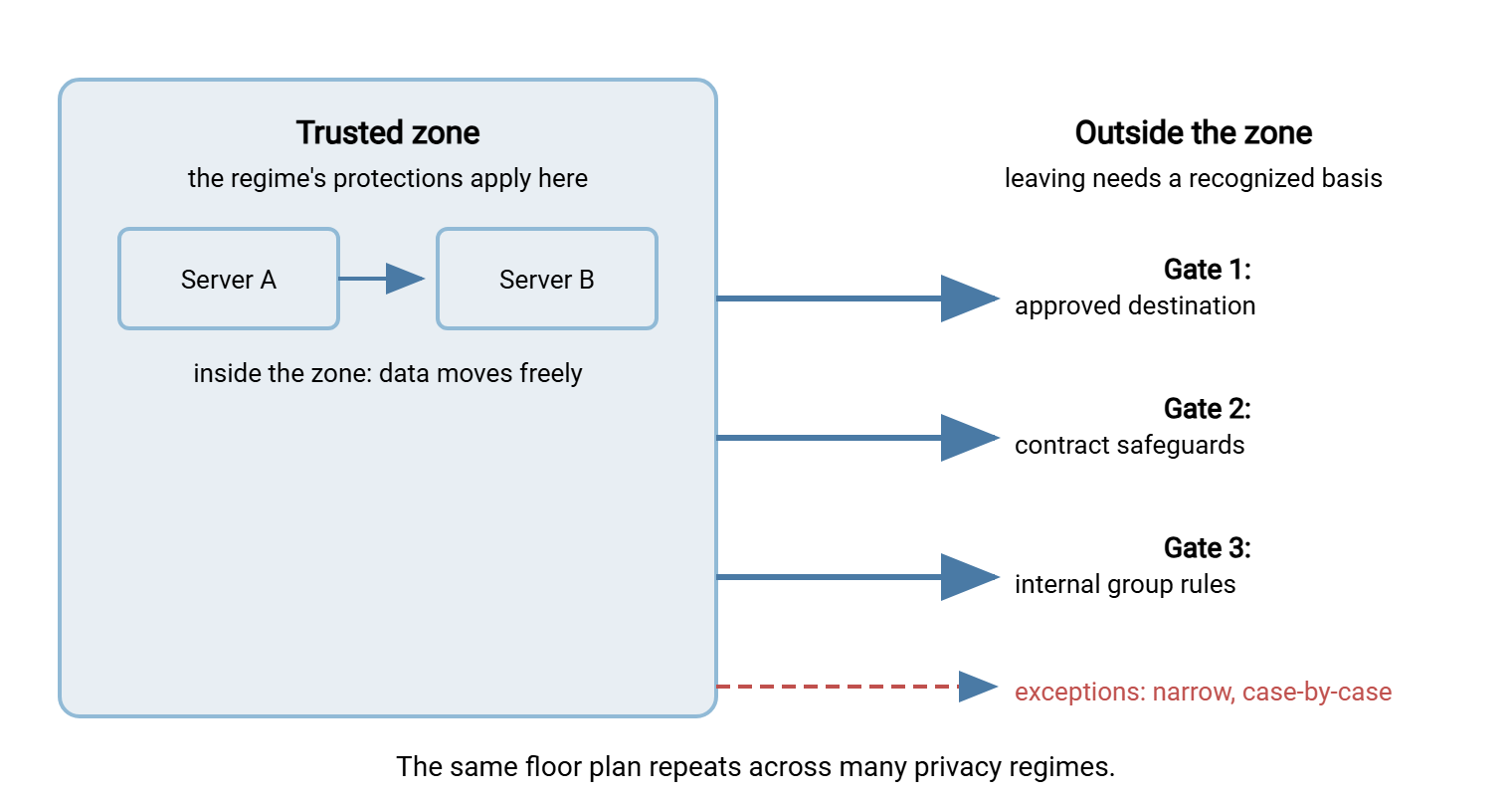
Two subtleties about the zone are worth absorbing before the tour. First, the zone is drawn by the regime, not by your org chart. A transfer to your own subsidiary outside the zone is an exit like any other. A transfer to an unrelated company inside the zone is not an exit at all. Second, an organization can stand in several zones at once. A company with offices in three regulated countries lives under three regimes simultaneously. A single flow can be an exit from one zone and an entry into another. Sorting out which regimes claim a given flow is textbook lawyer work; recognizing that the question exists is yours.
One caution as well: which gate applies to a given flow, and whether it is currently open for a given destination, moves with the law. Treat the gates as categories to recognize, never as permissions to assume.
Gate One: The Regulator Has Approved the Destination
The simplest exit is when the regime's own authority has looked at a destination country and formally found its protections comparable — an approval-style finding. The vocabulary varies; the word you will hear most often is adequacy. The logic: if the destination protects data about as well as home does, the guarantee travels built-in, and transfers there can proceed much like domestic ones.
Three things an administrator should understand about this gate. First, the list is not yours to keep. Which destinations currently hold a finding is exactly the kind of fact that changes — findings get granted, reviewed, and withdrawn. So that list lives with your legal team. Any list you hard-code into a wiki page will eventually be confidently wrong. (I have maintained that page. Nobody told it when the law moved, and it did not ask.) Second, nothing technical changes at your end. A flow through this gate looks like any other flow; the gate is pure legal status. Third — and this is the part that is yours — your flow records make legal change survivable. When counsel says "the finding for destination X was withdrawn, what do we send there?", the organization that keeps a geographic flow inventory answers in minutes. The one that does not begins an archaeology project. Building that inventory is the subject of Mapping Your File Flows by Geography.
A finding opens the border, but it does not switch off anything else — a point that trips people up. The data is still personal data; security duties, access limits, and logging expectations all continue to apply, exactly as they would for a domestic flow. The gate answers "may it leave?" — it says nothing about "may it be handled sloppily once it has."
Gate Two: The Parties Promise Safeguards by Contract
When no finding covers the destination, the most common gate is a contract. Sender and receiver sign terms in which the receiver promises to protect the data to the zone's standard. Regulators typically publish pre-approved wording for these promises. You will hear them called contract-based safeguards, and often, in GDPR-shaped conversations, standard contractual clauses. The guarantee no longer comes from the destination's laws; it comes from the receiving organization's binding commitments.
Those commitments are not abstract legal poetry, which is the part practitioners miss. They typically include concrete, checkable promises about how the data will be handled — and someone has to make each promise physically true on a server. That someone is you, on your end, and your counterpart at the partner, on theirs. The recurring promises translate directly into administrator work:
- "Data will be protected in transit." The flow runs over SFTP, FTPS, or HTTPS — never cleartext FTP. Our Encryption in Transit series covers the mechanics; your job is that the promised protocol is the configured protocol.
- "Access is limited to authorized personnel." Named accounts, least-privilege folder permissions, no shared logins, credentials retired when people leave.
- "Processing is logged and reviewable." Transfer activity logging is on, retained, and someone can produce it. On a server like Sysax Multi Server, activity logging to file and to a database is a setting you enable once. It becomes the standing evidence that the promised handling actually happens.
- "Data is deleted or returned when the relationship ends." Somebody must actually purge the folders and the archives — retention discipline, not intention.
- "Sub-contractors are disclosed and bound." If your partner forwards the data onward, that hop is part of the deal. Remember that when you map where the data really goes, as Where Your Transferred Data Actually Travels and Rests details.
Lawyers choose and sign the clauses; administrators are the reason the clauses are true. And the mirror image applies: when your organization is the receiver, the promises point at your servers. In that case, a partner in another zone sends data to you under their clauses. Their compliance team may ask you to demonstrate the encryption, the account restrictions, and the log retention you signed up to. Being able to answer with settings and samples rather than reassurances is the difference between a five-minute reply and a week of escalation. When a partner's security questionnaire asks pointed questions about one specific flow, this gate is usually why.
Gate Three: Rules Inside a Corporate Group
Multinational organizations move data between their own affiliates constantly — the subsidiary in one country sends personnel files to headquarters in another. Signing fresh contracts for every internal flow would be absurd, so many regimes offer a third gate. The group adopts binding internal rules for handling personal data and gets them approved by a regulator. It may then move data among its member companies under those rules. Think of it as the corporate group becoming a small trusted zone of its own, complete with border guards, who turn out to be you.
The administrator's translation is uniformity. Internal rules only mean something if the transfer server in every regional office actually meets the same bar. That means the same protocol requirements, same authentication standards, same logging, same retention. If your organization operates under group rules, the practical mandate is a common configuration baseline for transfer infrastructure everywhere, reviewed against drift. "Our sites each do their own thing" is the configuration-shaped opposite of this gate.
Northgate Retail's group rules said personnel data moved between affiliates only over encrypted protocols, to named accounts, with logging retained for a defined period. The first cross-site configuration review anyone had actually scheduled found one regional office still running an old cleartext FTP drop for "internal stuff." An HR export fed it every Monday. Nothing had left the company, and no file had gone anywhere unexpected. The hole was in the legal basis every other office relied on, not in the data. Retiring the drop took an afternoon. Explaining to compliance how it had survived years of "we are all on the same rules" took the rest of the week. That is why group rules turn configuration drift from an annoyance into a compliance event, and why the cross-site review is now on the calendar.
The Narrow Doors: Exceptions
Every regime also has a short list of situation-specific exits — usually called derogations or exceptions. One recurring example is that the person the data is about has explicitly consented to the transfer. Another is that the transfer is genuinely necessary to perform a contract with them (booking a hotel abroad requires sending the booking abroad). Or an emergency involving someone's vital interests demands it.
These doors are narrow on purpose. They exist for occasional, specific situations, not as a general-purpose bypass — regulators read heavy reliance on exceptions as a sign something is wrong. For an administrator, one rule of thumb captures it:
Remember: a routine, scheduled flow should never rest on an exception. If a nightly job crosses the border, it deserves a standing basis — a finding, contract safeguards, or group rules. The moment someone proposes "we'll just get consent" as the foundation for an automated recurring feed, route the conversation to legal before you build anything.
The Admin's Role, Mechanism by Mechanism
Pulling the gates together into one working reference — this is the table to keep next to your flow inventory:
| Mechanism (the gate) | What legal does | What the admin does |
|---|---|---|
| Approved destination (adequacy-style finding) | Tracks which destinations hold findings; flags changes | Keeps the flow inventory current so a legal change maps to affected flows immediately |
| Contract-based safeguards (e.g. standard contractual clauses) | Selects, signs, and maintains the clauses with each partner | Implements the promised controls: encrypted protocols, restricted accounts, logging, retention, deletion at end |
| Internal group rules | Drafts the rules, obtains regulator approval, audits the group | Enforces one configuration baseline on transfer servers across all group locations |
| Exceptions (consent, necessity, emergency) | Judges, case by case, whether an exception truly applies | Treats them as one-offs; escalates any recurring flow that leans on one |
Read down the right-hand column and notice the theme: the administrator's contribution is always the same four things. Those are accurate flow facts, correctly placed endpoints, controls that match what was promised, and logs that prove it. The mechanisms change; the contribution does not.
What This Looks Like on a Real Flow
Make it concrete with the flow this series keeps returning to: payroll files to an external processor in another country, nightly. Here is the division of labor from first email to steady state.
- The request arrives. HR wants the feed. You do not build it yet — you capture the facts. First, what data: payroll means names, pay, bank details — personal data by any definition (see our Personal Data in File Flows series). Capture the source location and destination location, and hand those facts to legal.
- Legal picks the gate. Counsel determines the destination holds no finding, so the flow will run under contract-based safeguards. Counsel signs the clauses with the processor. You are not part of this step, but its output lands on you.
- You make the promises true. The clauses promise transit encryption, restricted access, logging, and deletion. So the endpoint is the processor's SFTP server, with a verified location — ask, do not assume. Partner onboarding checklists like the one in Trading Partner Onboarding are where this question belongs. Use a dedicated account with access to exactly one folder. Keep activity logging on and retained; purge staging files on schedule.
- You put the flow on rails. A scheduled job in Sysax FTP Automation runs the transfer every night to that endpoint and no other, with retry and error handling. So the approved path is also the automatic path, and nobody improvises an email attachment when something hiccups at month-end.
- You record the decision. One line in the flow inventory: flow, endpoints, data class, "contract safeguards per legal, agreement ref," date verified. That line is what future-you produces when anyone asks "why is this allowed?"
Steady state is pleasantly boring: the job runs, the log accumulates, the record exists. Boring is what compliance looks like when it is working.
Keeping Your Footing When the Rules Move
This area of law moves, and that is the uncomfortable truth about it. Findings are granted and withdrawn; clause templates get revised; new regimes appear. Administrators sometimes conclude that the whole subject is quicksand and disengage; I did, for a while, and it was exactly backwards. The reason is worth internalizing: the pattern is stable even though the rulings are not. There will be a trusted zone; there will be gates; the gates will be roughly these four. What changes is which gate is open for which destination this year — and that is legal's watch, not yours.
Your stable assets are the ones no legal development invalidates. They are an accurate, geography-tagged flow inventory, endpoints placed where decisions require, controls that match promises, and logs that prove behavior. Organizations with those four things absorb a rule change as an afternoon of re-mapping. Organizations without them absorb it as a crisis. The next articles in this series build the assets: Mapping Your File Flows by Geography for the inventory, and Designing Sovereignty-Aware Transfer Flows for placement and rails.
Frequently Asked Questions
What are standard contractual clauses, in one sentence?
Do these rules mean we cannot use a provider in another country?
What does "adequacy" mean when lawyers say it?
Can we just get consent and skip the other mechanisms?
If lawyers make all the decisions, what exactly is my role?
Does encrypting the transfer satisfy the restrictions by itself?
From the Sysax team: we build secure file transfer software for Windows. Sysax Multi Server is an FTP, FTPS, SFTP, and HTTPS server. Sysax FTP Automation handles scheduled, scripted transfers. Free trials are on the download page.