
From Annual Audit Panic to Continuous Compliance
The audit announcement lands on a Wednesday. By Friday there is a shared document called "Audit Prep," a color-coded spreadsheet, and a pizza budget. Most transfer teams know both halves of that story. For eleven months, compliance is a background hum. Reports run or don't, reviews slip, the evidence folder gathers dust, and every improvement is filed under "after the busy season." Then the second mode begins: weeks of archaeology. You reconstruct what happened months ago from whatever records survived, format spreadsheets at midnight, and promise each other that next year will be different. Next year, it isn't.
There is a third mode, and it is less work in total, not more. I have run all three, and the third is the only one I did not resent by March. Continuous compliance means the controls that the audit will test simply run all year on a modest calendar. They generate their own evidence as a byproduct. You test them before anyone else tests them, with drift caught near the moment it happens. The audit then changes character entirely: instead of excavating the past, you demonstrate the present, and hand over folders that filled themselves.
This closing article of our Audit-Ready Reporting series assembles the earlier pieces into that rhythm. It explains why the annual scramble fails structurally and the control calendar that replaces it. It covers the self-testing habit, evidence-as-you-go, and the drift detection that keeps the whole thing honest between audits.
Why the Annual Scramble Fails Structurally
The pre-audit panic is not a character flaw; it is a strategy, and it fails for reasons built into how audits work. The deepest one: evidence has a timestamp, and the past does not accept deposits. Auditors need proof that controls operated across the whole audit period — every month of it. If the access review did not happen in the spring, no autumn effort can create the record of it happening. The only thing autumn can produce is a review dated autumn, and a gap where spring should be. The one way to fill that gap after the fact is fabrication, which is the single unforgivable act in the entire audit relationship. Scrambling can polish what exists; it cannot mint history.
The second failure is memory. The auditor will ask about the March configuration change, the May partner onboarding, the odd gap in June's logs — and eight months later, nobody remembers. Records made at the time answer in a sentence; reconstructions made under deadline answer with guesses, and guesses corrode credibility. The third failure is the repeat finding. Remediations promised under audit pressure get built in a hurry, run for a quarter, and quietly stop when attention moves on. So the next audit rediscovers last year's finding, now wearing the more serious label of a commitment not met. And the fourth is simple arithmetic. The same total effort, concentrated into three miserable weeks, costs more — in overtime, in errors, in goodwill. It costs less spread across a year in hour-sized pieces. (The pizza is not free either.)
Acme's first audit produced a finding about undetected transfer failures. The team built the weekly exceptions report over a weekend, in the glow of a freshly signed management response. It ran faithfully for a quarter. Then the service account's password expired in the spring, and the job began failing quietly. Since the report was the thing that would have noticed a failing job, nothing did. When the next audit's request list arrived, the evidence folder held three months of reports and nine months of nothing. The finding came back wearing a new label: commitment not met. The monthly "did every expected file arrive" row on Acme's calendar was written that afternoon.
Remember: operating-effectiveness evidence cannot be backfilled. Whatever the calendar says today is the oldest evidence you will ever be able to show for today. That single fact is the entire argument for starting the rhythm now rather than after the next audit.
Continuous Compliance in Plain Words
Strip the buzzword and continuous compliance is four habits, none of them exotic:
- A control calendar: every recurring control task — reports, reviews, checks — has a calendar slot, a named owner, and a defined evidence output.
- Self-testing: a few times a year, you test your own controls the way an auditor would, and record the result.
- Evidence as you go: every calendar task ends by filing its output in the evidence tree, dated and named, the day it is produced.
- Drift detection: standing checks that notice when configuration, scope, or the controls themselves wander from what you documented.
Absent from that list: a compliance dashboard, a new product, a budget line. Continuous compliance is an operating rhythm, not a purchase. (A server health dashboard is a fine thing and a different thing; building a server health dashboard covers it.) The division of labor stays the same as everywhere in this series. Your compliance function or the frameworks you answer to decide which controls the organization commits to and how often they must run. The mapping from specific regimes to transfer controls is the territory of our compliance frameworks series. The administrator's contribution is turning those commitments into calendar rows that actually execute, and evidence that they did.
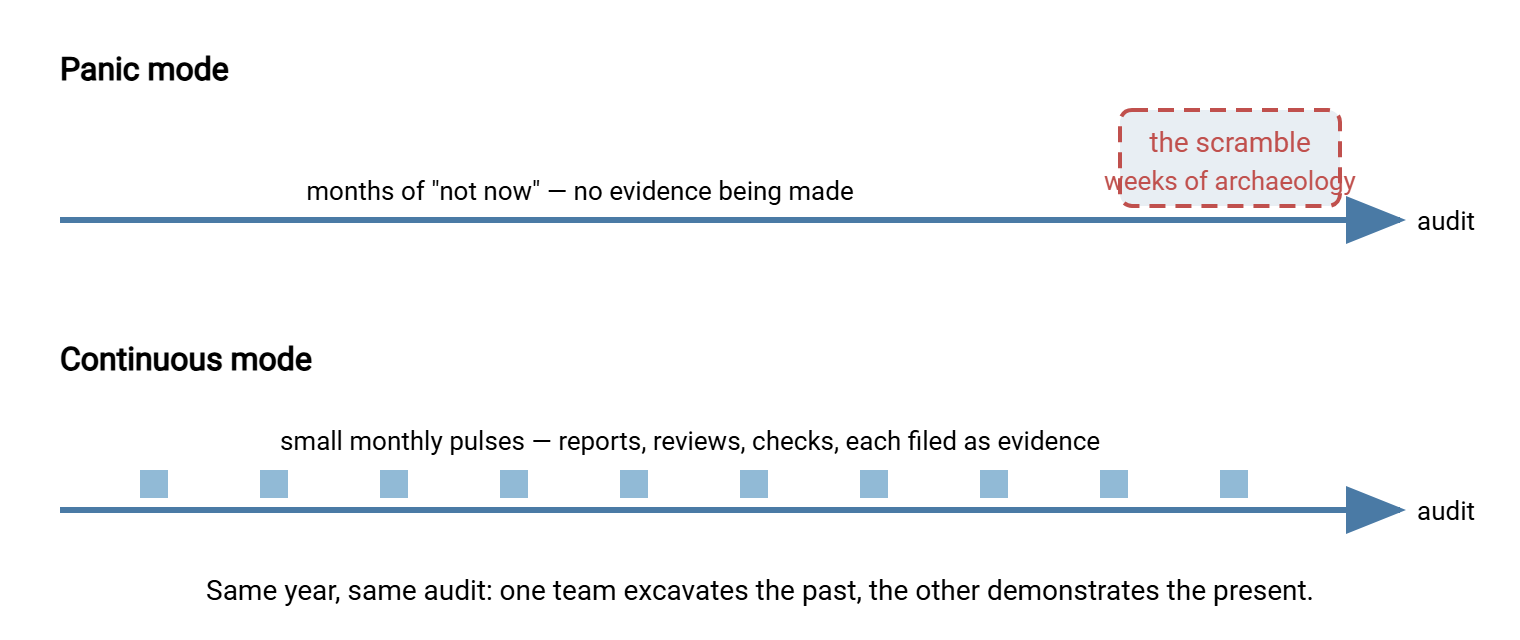
Across a year, the two modes look like this. Panic mode is a flat line of neglect ending in a spike of scramble at audit time. Continuous mode is a steady pulse of small tasks — and the audit becomes just one more pulse.
The Control Calendar
The calendar is the backbone, and it fits on one page. Every row is a control task with a cadence, an owner, and — the part teams forget — a named evidence output. So "done" always leaves a trace. A working example for a modest transfer estate:
TRANSFER CONTROL CALENDAR  --  one page, five cadences

WEEKLY (Mon morning, ~20 min)             owner: admin
  review failed sign-in + exception reports
  evidence: reply-to-report trace, tickets for anomalies

MONTHLY (1st week, ~1 hr)                 owner: admin
  confirm all standing reports generated and filed
  export config; diff against last month; explain every change
  scan account report for new/dormant accounts
  evidence: filed reports, config diff note, initialed checklist

QUARTERLY (~half day)                     owner: admin + owners
  access review: population, attestations, removals, re-pull
  self-test one control (rotate; see below)
  certificate and key expiry horizon check
  evidence: attestation record, self-test record, expiry note

TWICE A YEAR (~1 hr)                      owner: admin + manager
  walkthrough dry run of one flow, cold
  review retention settings against policy
  evidence: dry-run notes, retention confirmation

ANNUAL (~half day)                        owner: manager
  lock prior-year evidence folders read-only
  re-read control list against current frameworks
  confirm calendar owners still exist and accept
  evidence: archive note, updated calendar, sign-off
Three rules keep the calendar alive where good intentions die. Attach rows to rituals that already survive — the patch window, the first-Monday team meeting — because a task with a home outlives a task with a reminder. Protect the slots like maintenance windows; a skipped quarter is a hole in the period that no later diligence repairs. And give every row exactly one owner. Shared ownership is how a task becomes nobody's. The annual owner-check row exists because people change jobs and calendars do not notice on their own. A calendar will remind an empty desk for years without complaint.
Self-Testing: Audit Yourself Before Anyone Else Does
Once a quarter, spend an hour being your own auditor: pick one control and run the same test an outsider would, against real records. The point is not ceremony — it is that controls fail silently. The choice is between finding the failure yourself in October or having it found for you in the report. Rotating tests that earn their hour:
- The leaver test. Take three recent leavers from HR's list and verify each transfer account is disabled, with the disable date in the change log. This is the most common audit test there is; running it yourself first means it can never surprise you.
- The cleartext test. Attempt a plain FTP connection to your own server and confirm it is refused. If you have formally retired cleartext, this is the recurring proof described in proving FTP is gone.
- The review-trace test. Pick a random week from two months ago and find the review trace for its reports. If you cannot find it in five minutes, neither can anyone else.
- The restore test. Retrieve one archived log from deep in the retention window and open it. Retention that has never been restore-tested is a promise, not a control — the retention design itself is covered in the logging series' audit-ready reporting from transfer logs.
- The alert test. Trigger a harmless failure — a deliberately wrong password after hours, a test job pointed at a missing folder — and verify the alert arrives and someone acts on it.
Write each result down — test, date, sample, outcome, action — and file it in the evidence tree. A folder of dated self-test records includes the ones that found problems and the fixes that followed. It is close to the strongest control-environment evidence a small team can produce. It shows the controls are watched by people who want to know the truth about them. And when a self-test fails, treat the failure as the system working: fix it and record it honestly. Remember from surviving the transfer audit walkthrough that a self-identified issue with a dated fix lands entirely differently than a discovered one.
Evidence As You Go
The filing habit is what converts routine work into audit readiness, and it costs minutes when done at the time. Every calendar row ends the same way. The output — report, attestation, diff note, self-test record — lands in the evidence tree from transfer evidence auditors accept and reject. It lands under its control and period, named by convention, the same day. Never "I'll file these at the end of the month"; end-of-month filing is how panic mode re-enters through the back door.
Most of the volume should arrive without human hands at all. The standing reports from the transfer reports worth automating are the calendar's mechanical layer. A scheduled job in Sysax FTP Automation can deliver each export to the evidence share on its schedule and email the team that it ran. That notification stream doubles as the calendar's heartbeat, because a missing email is your earliest sign that a control quietly stopped. Beneath it all sits the raw record. A server such as Sysax Multi Server logs every session to file and to a database, with rollover keeping the files manageable. That is what makes any month of the period queryable on demand. The automation is the pulse; the log store is the memory; your calendar rows are the judgment layer on top.
Drift Detection: Catching the Quiet Changes
Drift is the gap that opens, gradually and silently, between what you documented and what is true. It comes in four flavors, each with a cheap detector:
- Configuration drift. Settings change without a ticket. A protocol is re-enabled during a late-night debug, an IP allowlist entry is added "temporarily," or a folder permission is widened for a one-off and never narrowed. Detector: the monthly config export and diff, where every difference must map to a recorded change. Ten minutes, and nothing "temporary" survives a month unexamined.
- Scope drift. New flows and partners appear that nobody assessed. A department quietly starts sending files to a new destination, and your documented inventory no longer describes reality. Detector: the monthly account report surfaces new accounts; a periodic flow inventory — the file flow census — catches the rest.
- Control drift. The controls themselves decay: the report job that stopped after a password change, the alert rule pointing at a departed employee's mailbox. Detector: the monthly "did every expected file arrive" check, plus the quarterly alert self-test.
- Ownership drift. Calendar rows owned by people who changed roles. Detector: the annual owner confirmation — dull, and the reason the calendar still works in year three.
For changes that should not wait for the month's diff — an administrator permission change, logging switched off — real-time alerting is the right layer, covered in alerts from transfer logs. Together the two form a familiar pattern. Alerts catch the sharp changes now, and the monthly diff sweeps up the gradual ones. The same philosophy — verify continuously rather than trust the last assessment — is the compliance-flavored cousin of continuous verification and monitoring in the zero-trust series.
When the Audit Arrives
Run this rhythm for a year and the audit experience inverts. The request list arrives and maps, row by row, onto folders that already exist — populated, dated, consistent month over month. The interview questions from the start of this series get answers backed by records made at the time. The walkthrough becomes a demonstration of what you do anyway, in front of witnesses. Even sampling gets easier on you. Populations that reconcile cleanly and samples that keep passing give the auditor what they need without expansion. Every miss in a scramble-mode audit tends to widen the testing.
Findings still happen — a year of rhythm does not make an estate perfect. But their character changes: fewer "the control did not operate" findings, which are the painful kind, and more forward-looking refinements. And your management responses become commitments you can keep, because they are calendar rows, not resolutions. (Resolutions are made in the third week of the scramble and forgotten in the fourth.)
Starting Small — Especially If an Audit Is Coming
Do not attempt the full calendar in one heroic month; that is panic mode wearing a new hat. A sequence that sticks: in the first month, stand up two automated reports and the evidence tree, and start filing. The next month, run your first access review and file the pack. The month after, run one self-test and the first config diff. By the end of a quarter, the one-page calendar exists with owners against every row, and each following quarter adds a row or improves one.
If an audit is already on the horizon, the same advice holds with one addition: start the rhythm now anyway. Evidence from the last few months before fieldwork is still evidence. A control that demonstrably ran for a quarter beats one that never ran at all. Be straightforwardly honest about when each control began. What you must not do is manufacture the appearance of history. Auditors read start dates without resentment; they read fabrication as the end of trust.
Remember: the goal is not a bigger compliance project — it is a smaller, permanent one. An hour a week, a half-day a quarter, filed as you go, beats three weeks of archaeology every year. It is the only version that also makes the transfer estate genuinely safer between audits.
The Series, In One Paragraph
Auditors ask predictable questions, twice each — design and operation. Evidence convinces when it is system-generated, dated, complete, and reproducible, and it convinces fastest from a folder that filled itself. Five standing reports answer most requests. The quarterly access review catches the rot that accumulates by default. The walkthrough rewards honest preparation. The control calendar turns all of it from an annual emergency into a quiet routine. That is audit-readiness: not a season, but a rhythm. Every piece of it is within reach of a small team with a transfer server, a scheduler, and a folder structure. Next year can, in fact, be different.
Frequently Asked Questions
Do we need special software for continuous compliance?
How much time does this actually take?
Is continuous compliance the same as continuous monitoring?
What should we do when a self-test fails?
Does running all this mean the audit will skip testing us?
The audit is three months away and we have none of this. Where do we start?
From the Sysax team: we build secure file transfer software for Windows. Sysax Multi Server is an FTP, FTPS, SFTP, and HTTPS server. Sysax FTP Automation handles scheduled, scripted transfers. Free trials are on the download page.