
Why Your Organization Needs a File Transfer Policy
Ten past four on a Thursday. Someone in sales has a customer list, a five o'clock deadline, and no idea how to send it. The person at the next desk says, "I just drop it in my personal cloud folder and share the link, it's fine." Your file transfer policy has just gained a clause. Nobody wrote it down, nobody will tell you, and it took effect immediately. Every organization has this policy. Most have never read theirs; it is the sum of whatever worked last time, amended daily by people under pressure who mean well.
This article makes the case for replacing that improvised policy with a written one. Not a binder, not legalese: a short document that answers "how am I supposed to send this?" before people answer it themselves. It covers what a real discovery exercise turns up, and what improvisation costs you later. It explains why a written policy is the best backup an administrator can have. It also explains how to answer the objections you will hear when you propose one. It is the opening article of our Writing a File Transfer Policy series.
What a File Transfer Policy Is — and Is Not
A file transfer policy is a short written statement of how files are allowed to move into, out of, and around your organization. At minimum it names the approved tools for each common need and lists the methods that are off limits. It explains how to request an exception, and says who owns the rules. That is the whole job. Done well, it fits on a page or two.
It helps to be equally clear about what a file transfer policy is not, because the word "policy" drags in baggage that scares people off:
- It is not a technical standard. Cipher choices, port numbers, and server hardening settings belong in your internal build documents, not in a policy read by the sales team. The policy says "use the company transfer server for files going to partners"; the standard says how that server is configured.
- It is not a legal document. Legal or compliance people should read it before it ships, and HR decides what happens when someone ignores it repeatedly. But the text itself should be written in the same plain language as an email to a colleague.
- It is not a wall of prohibitions. A policy that is nothing but "don't" teaches people to stop reading. The heart of a good policy is the approved list — the yes — with the forbidden list as its shadow. We spend a whole article on that structure in defining approved and forbidden methods.
- It is not the admin's personal property. You will likely draft it, because you know where the files actually go. But management signs it and owns it. That signature matters more than any sentence in the document, for reasons we will get to shortly.
Notice the division of labor built into that list. The administrator drafts the policy, builds and runs the approved tools, and advocates for realistic rules. Management approves the policy and owns the risk decisions. HR and legal own consequences and review. If you find yourself doing all four jobs, the document will not survive its first real conflict — part of proposing a policy is proposing that split.
The Inventory That Changes Minds
Abstract arguments for a policy rarely move anyone. An inventory does. You may need to convince leadership — or yourself — that the improvised approach has gotten out of hand. If so, spend a week quietly cataloging how files actually leave your network today. The systematic version of this exercise is described in our file flow census article; even the quick version is eye-opening.
Here is a composite of what such an exercise finds at a typical mid-sized company. It has a few hundred employees, one or two administrators, nothing unusual about the business. Every item below is the kind of thing real discovery passes turn up:
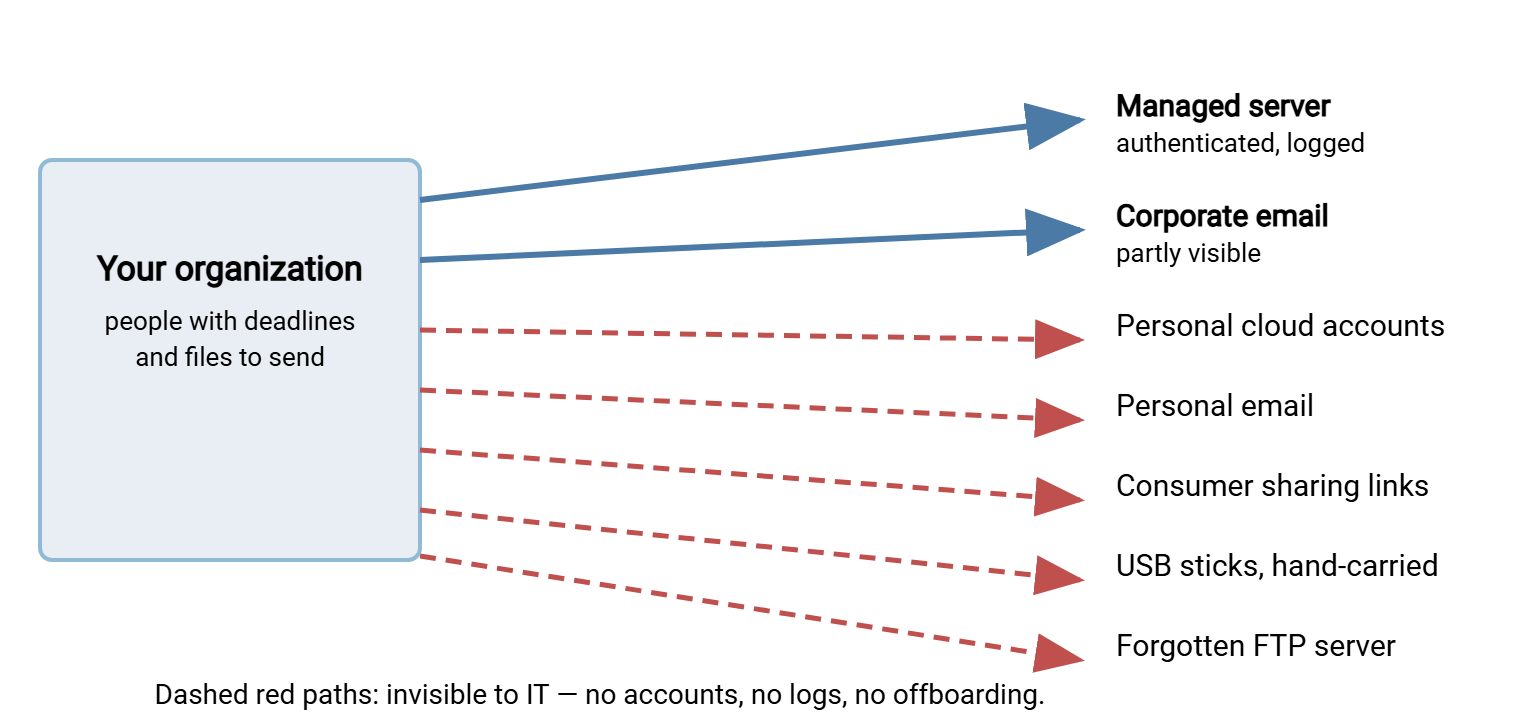
- Eleven personal cloud storage accounts holding work files, discovered from sync-client installs and browser traffic. Two belonged to employees who had left; the folders they shared were still accessible to them.
- A monthly payroll spreadsheet going to the external accountant from a manager's personal email address, because the corporate mailbox once rejected it for size and the workaround stuck.
- Dozens of consumer file-sharing links in sent mail, created for one-off deliveries. Several had no expiry and were still live, still serving old proposals and price lists to anyone with the link.
- A USB stick routine — production drawings hand-carried to a machine shop across town every week, a practice nobody could date the start of.
- A forgotten FTP server from an earlier era, still reachable from the internet, still speaking cleartext, with an anonymous upload folder that strangers had already found. (If that one sounds familiar, our guide to locking down guest access is the fix.)
- A scheduled task on a workstation under a desk, pushing a nightly report to a partner using credentials belonging to an employee who had resigned. Nobody currently at the company knew the job existed. It had failed silently twice already.
None of it is malicious. Every item exists because a real business need met an official toolset that could not serve it, and a resourceful person closed the gap. This is shadow IT — systems and services adopted for work without IT's knowledge or approval. It is best understood not as misbehavior but as unmet demand. People bypass rules and tools that block their work (why shadow sharing happens has the full anatomy). Any policy that ignores that fact is a press release, not a policy.
The diagram below shows the same finding in one picture: the paths files take out of an organization before a policy exists. One or two doors are managed and logged; the rest are invisible.
What the Improvised Approach Costs
Shadow transfer paths feel free. Each one solved an urgent problem at zero apparent cost. The bill arrives later, and it always arrives in one of four envelopes.
The offboarding bill. When someone leaves, you disable their directory account and their email. You cannot disable their personal cloud account, because it is theirs — and every work file synced or shared through it leaves with them. The overlap between departing employees and lingering access is one of the most common findings in insider-risk reviews of file transfer. Shadow paths are its main cause. The leaver checklist collects the badge, the laptop, and the parking pass; it has no line for a folder called "work stuff."
The incident bill. Something may go wrong — a misdirected file, a compromised account, a partner reporting data they should not have. That day, the first questions are: what exactly left, when, and to whom? On a managed path, the transfer log answers in minutes. On a shadow path there is no log, which means the honest answer is "we cannot rule anything out." Everyone from lawyers to customers treats the worst case as the working assumption.
The continuity bill. The nightly report pushed from under a desk stops the day its author's account dies. Nobody notices until the partner escalates. Undocumented flows have no monitoring, no retries, and no second person who knows they exist — reliability by luck. (The partner is the monitoring system, and it has no dashboard.)
The sprawl bill. Every shadow path is another place copies of your data accumulate. Those copies have no retention rules, no encryption you chose, no way to honor a deletion obligation. If your organization ever has to answer for where personal data lives, sprawl is what makes the question unanswerable. Our retention and deletion series exists largely because of it.
Remember: shadow transfer paths are unmet demand, not sabotage. The costs above are real, but the people creating the paths are trying to do their jobs. A policy that provides good approved paths removes the demand; a policy that only forbids things redirects it somewhere quieter.
The Policy Backs Up the Person Who Says No
The argument that lands hardest with working administrators is about self-defense.
Without a written policy, every refusal is personal. A department head wants to move a customer list through a consumer sharing site today, because the deadline is today. You say no. What the department head hears is: Alex is being difficult. The argument is now your judgment versus their urgency, and they outrank you or know someone who does. Repeat that scene a few times and you learn to stop saying no. I have lost that argument, and the unwritten policy gained a clause each time.
It went that way at Meridian Parts: a sales director needed a customer list at a distributor by five. The administrator offered a transfer account in ten minutes. The director said a sharing link was faster and the process could be sorted out later. The link had no expiry. The discovery inventory found it fourteen months on, still live, and the administrator spent two days confirming nobody else had opened it. The one-page policy that followed was signed by the same director, the same week.
With a written policy, the same conversation changes shape. The company — not you — decided that customer data travels through the managed server. You are not the author of the refusal but the person helping them succeed within it: "here's the approved way, ready in ten minutes." If the approved way genuinely cannot serve them, the exceptions process turns "no" into "not that way, but here's who can authorize an alternative." The argument is now between the employee and a document that management signed, and you no longer have to win it personally.
The management signature is therefore worth more than any paragraph of the text, and routing your draft through leadership for approval is not bureaucratic theater. An unsigned policy is one admin's opinion, formatted nicely. A signed one is the organization speaking. Proposing the policy is really proposing that leadership put its weight behind answers you are currently improvising alone.
The same document backs up your yes, too. When the approved list exists, most requests stop being judgment calls. Anyone can look up "sending a large file to a partner" and get the sanctioned answer without waiting for you. That is quietly the biggest time-saver a policy delivers.
What Auditors and Assessors Expect
None of this is legal advice — your compliance or legal people own the interpretation for your organization. But the pattern across regulatory and industry frameworks is consistent enough to state plainly. Whether the framework is HIPAA, PCI DSS, or a GDPR-style privacy law, assessors keep asking the same two questions about data in motion. Do you control how it moves? Can you show me?
A written transfer policy is usually the first document requested, because it is the design half of the answer. It proves that the organization decided, on purpose, how files should move. Logs, account lists, and server settings are the operating half — proof the decision is actually followed. Design without operation is a nice document; operation without design looks like an accident that happens to be working. Auditors want both, and the policy is the cheap half. Our compliance frameworks series maps what each regime asks of transfers. The audit-ready reporting series covers the evidence side.
Buying blocking and monitoring products before writing the policy is the ordering mistake that wastes real money. You are hoping technology will impose order that was never defined. That approach gets the sequence backwards — a scanner cannot tell allowed from forbidden until someone writes down which is which. The argument is laid out in policy before tooling: the policy is the specification; enforcement tools are one possible implementation.
"We're Too Small for a Policy" — the Objections, Answered Honestly
Propose a transfer policy and you will hear a handful of predictable objections. They deserve straight answers, because each contains a half-truth.
"We're too small." Small organizations improvise more, not less: with no procurement process slowing anyone down, shadow paths appear faster per capita. The outside world does not grade on size. The customer whose data leaked and the assessor reviewing your practices expect the same of twenty employees as of two thousand. The honest concession: a small organization needs a small policy. One page. An afternoon to draft. The objection is really to imagined bureaucracy, and the fix is to not write bureaucracy.
"We trust our people." Good — the policy is not about trust. Trustworthy people improvise when the official way is missing or blocked; that is what most of the inventory above was. A policy is a map for people you trust, not a leash for people you don't. And when an incident happens anyway, "we trusted everyone" is not an account of your controls that anyone outside the building will accept.
"It will slow us down." A badly written policy will, and people will then route around it, which is worse than no policy because it adds pretense. A well-written one speeds up the common cases. Nobody burns twenty minutes inventing a delivery method, and nobody waits for the admin to adjudicate routine sends. Making the rules fast to follow is a craft of its own, the subject of writing rules people actually follow.
"We'll write it after the busy season." The unwritten policy is being amended right now. Every month of delay adds users, habits, and live links to the shadow paths you will eventually have to migrate. The cost of the written policy is roughly constant; the cost of the cleanup compounds. The busy season, in my experience, is followed by the other busy season.
"A policy won't stop a bad actor." Correct; concede it immediately. A determined insider is a different problem with different controls. The policy serves the well-meaning majority and, as a side effect, makes the rare deliberate case legible. Once approved paths exist and are easy, choosing a covert one stops looking like resourcefulness and starts looking like intent.
A Starter Skeleton You Can Copy
The skeleton below is the entire structure of a workable first policy; the rest of this series fills in each section. Paste it into a document and start writing sentences under each heading.
FILE TRANSFER POLICY — skeleton

1. PURPOSE       Two sentences: files moved for work purposes use
                 approved methods, so the company can protect data
                 and answer for where it went.

2. SCOPE         Who it covers (all staff, contractors) and what
                 (any work file moving to, from, or outside the
                 company network — any size, any format).

3. APPROVED      The tool for each common need:
   METHODS       - files to/from partners and customers -> [server]
                 - recurring automated feeds            -> [tool]
                 - internal day-to-day files            -> [share]
                 - small ad-hoc documents               -> email, within limits

4. FORBIDDEN     Off-limits methods, each paired with its approved
   METHODS       alternative: personal email, personal cloud
                 accounts, consumer sharing sites, cleartext FTP,
                 unmanaged USB media.

5. EXCEPTIONS    How to ask, who decides, how fast you get an
                 answer, and how long an exception lasts.

6. ROLES         Management owns the policy. IT runs the approved
                 tools and reviews logs. HR handles repeated or
                 willful violations.

7. REVIEW        Re-read and refresh once a year, or after any
                 incident that reveals a gap.
Two sections of the skeleton depend on infrastructure actually existing; this is the administrator's half of the bargain. "Approved methods" is only honest if the approved method works today. Something like Sysax Multi Server fills the partner-and-customer line — an FTP, FTPS, SFTP, and HTTPS server on your own Windows machine. It has per-account access from built-in accounts or Active Directory, IP allow and block lists, and activity logging to file or database. So the sanctioned door is also the visible one. The recurring-feeds line is what a scheduler such as Sysax FTP Automation exists for. It provides scheduled and scripted transfers with folder monitoring and email notifications. That way, the nightly job runs from a server with logs instead of from under someone's desk. Whatever tools you choose, stand them up before the policy names them — a policy pointing at vaporware trains everyone to ignore it. Before, not "in parallel with the rollout."
Remember: the skeleton is deliberately short. If your first draft outgrows two pages, you are probably writing technical standards or legal boilerplate into it. Move the detail elsewhere and keep the policy answerable in one read.
Where This Series Goes Next
An unwritten transfer policy already governs your organization, written by deadlines and maintained by workarounds. It offers no logs when incidents come, no offboarding when people leave, no answer when auditors ask, and no backup when you have to say no. A written policy — short, plain, signed by management, with an approved path for every real need — replaces improvisation with a map. It is among the highest-leverage documents an administrator can get adopted, and drafting it costs an afternoon. The unwritten one is being drafted this afternoon too, by whoever has a deadline at five.
From here, the series builds the document piece by piece. Start with defining approved and forbidden methods — the two lists at the policy's heart and the rule that every "no" must come with a "yes." Then writing rules people actually follow turns the lists into language that survives contact with busy humans. When the draft is real, the rollout and enforcement articles take it the rest of the way.
Frequently Asked Questions
What is a file transfer policy, in one sentence?
Who should write the policy — IT or management?
What is shadow IT?
Does a small company really need a written policy?
Will a policy actually stop people from using personal accounts?
Is the transfer policy the same as an acceptable use policy?
From the Sysax team: we build secure file transfer software for Windows. Sysax Multi Server is an FTP, FTPS, SFTP, and HTTPS server. Sysax FTP Automation handles scheduled, scripted transfers. Free trials are on the download page.