
Offboarding Partners Without Breakage
"Do we still work with Cedar Freight?" "I think so. Their account is still enabled." That exchange is the whole problem in two lines: an enabled account is not evidence of a relationship, only of an offboarding that never ran. Walk through any transfer server that has run for a few years and you will find them. There are accounts for partners whose contracts ended long ago, and folder trees still hold their files. A scheduled job still faithfully generates an extract that nobody has fetched in fourteen months. Onboarding gets runbooks and celebrations; offboarding gets silence. The lifecycle that began so carefully never ends. It just stops being mentioned.
Skipping the ending creates two opposite failure modes, and estates usually manage to have both. The first is orphaned access: a working credential held by an organization that no longer has any duty of care toward you. Nobody on their side is rotating it, watching it, or even aware it exists, which makes it among the most dangerous credentials in your estate. The second failure mode belongs to the administrator who finally decides to clean up and deletes everything in one satisfying afternoon. Then, over the following month, they discover what still depended on that partner's setup. There is the internal job that read their folder, the monitoring check now alarming daily, the sibling company quietly sharing their connection. I have been that administrator. The afternoon was excellent and the month was not.
This article is the runbook for the ending. It covers the triggers that tell you an offboarding is due and the dependency checks that come before touching anything. It explains the disable-then-observe-then-delete sequence that makes breakage nearly impossible, plus the retention duties that outlive the connection. It includes a complete checklist to copy. It closes the lifecycle this B2B Partner Exchange series began. The goal is the same as everywhere else in the program: endings so routine they are boring. "I think so" stops being an acceptable answer somewhere around the second heading.
Why Offboarding Never Happens by Itself
Offboarding fails structurally, not through laziness. Three forces guarantee it:
- No trigger reaches IT. Contracts end in a business system, and relationships wind down in account managers' inboxes. Nothing in either process files a ticket that says "retire the file exchange." The connection keeps working, so it looks alive.
- No owner. Onboarding has a requester who chases it. Offboarding benefits nobody visibly. The partner is gone, the business has moved on, and the only person who could care is an administrator who has not been told.
- Fear beats hygiene. Leaving an account enabled risks nothing visible today. Disabling it might break something today. Every busy team resolves that asymmetry the same way, which is how accounts outlive relationships by years.
The result is a growing shadow estate of enabled-but-unowned access, unmatched folder trees, and jobs serving nobody. These are precisely the accounts that periodic access reviews exist to catch. They are precisely the ones nobody can answer for when the review finally asks. If your organization already reviews transfer access on a rhythm — and it should, see periodic access reviews for transfer systems — every unexplained partner account it surfaces is an offboarding that never ran. I have never sat through a review that surfaced none. The same dynamic applies one level down, to individual keys left behind by departed staff. That is its own discipline: retiring keys at offboarding. The same dynamic also applies to the staff accounts themselves, in offboarding that closes the account.
Triggers: How Endings Announce Themselves (If You Listen)
Since no trigger arrives on its own, the program installs its own listeners. Four cover practice:
- The date you captured at onboarding. The partner register — built in running partner exchange as a program — carries a contract end or next-review date per partner. A monthly glance at that column is the cheapest offboarding trigger in existence, and it was free the day you recorded it.
- The business owner. Every register row names the person inside your organization who owns the relationship. Ask them annually, one line per partner: still live? The answer "oh, we stopped working with them last spring" is an offboarding ticket wearing a surprised expression.
- Replacement events. Migrations, consolidations, and channel changes end flows implicitly. For example, the partner moved to your new platform, or to a different exchange method. The old path should die on a schedule rather than linger as a fallback nobody watches.
- Dormancy. The server's own records are the listener of last resort: an account with no successful connection in ninety days is asking a question. Dormancy is not proof of an ending — quarterly and seasonal flows sleep legitimately. But it is always worth an inquiry, and your activity logs make the inquiry a query rather than a project.
Whichever trigger fires, the first step is the same: confirm with the business owner, in writing, that the relationship is actually ending. Offboarding executed on a rumor is how you learn that "we stopped working with them" meant one division out of three.
Meridian Parts learned how quiet an ending can be when a periodic access review flagged a supplier account with no successful login in over a year. The register still said "active"; the business owner had changed roles; the contract, once someone found it, had ended the previous summer. The account had a working key and write access to an inbound folder the whole time. Nothing had been sent and nothing had been taken; the only thing that had happened was nothing, for a year, with full permissions. They ran the complete sequence on it, disable and window and sweep. Then they added the dormancy query to the monthly review, which turned up two more in the following quarter.
Dependency Checks Before You Touch Anything
The breakage in a botched offboarding almost never comes from the partner — they left. It comes from everything on your side that quietly grew around their setup. So before anything is disabled, map the dependencies. The general method is in dependency mapping for flows. The partner-specific version is five questions, answered from evidence:
- Is anything still arriving or being fetched? Pull the last few months of the partner's activity from the server logs. Activity during a supposedly dead relationship means the business confirmation was wrong somewhere — stop and re-ask before proceeding.
- Which internal jobs read their folders? Collection sweeps, decryption steps, loaders — anything pointed at
/partners/CEDARF/will error, loop, or (worse) silently process stale files after the tree changes. Search the job configurations, not memories. - Which of your jobs still produce for them? Outbound generation and push jobs keep running after relationships end, burning compute. If the push credential still works, they keep delivering data to a company with no right to receive it. That last case is not clutter; it is a disclosure.
- What infrastructure is partner-specific — and what is secretly shared? IP allowlist entries, firewall rules, DNS names, certificates. If the isolation practices from credentials and security across many partners held, nothing is shared and each item maps cleanly to this partner. Verify anyway; offboarding is where isolation violations from years past surface.
- Which monitoring checks watch their flows? Expected-file and freshness checks must be retired with the flows they watch, or they will alert forever. A monitoring channel that cries about a retired partner every morning teaches everyone to ignore it. That is how the next real miss slips through (see freshness checks and expected files).
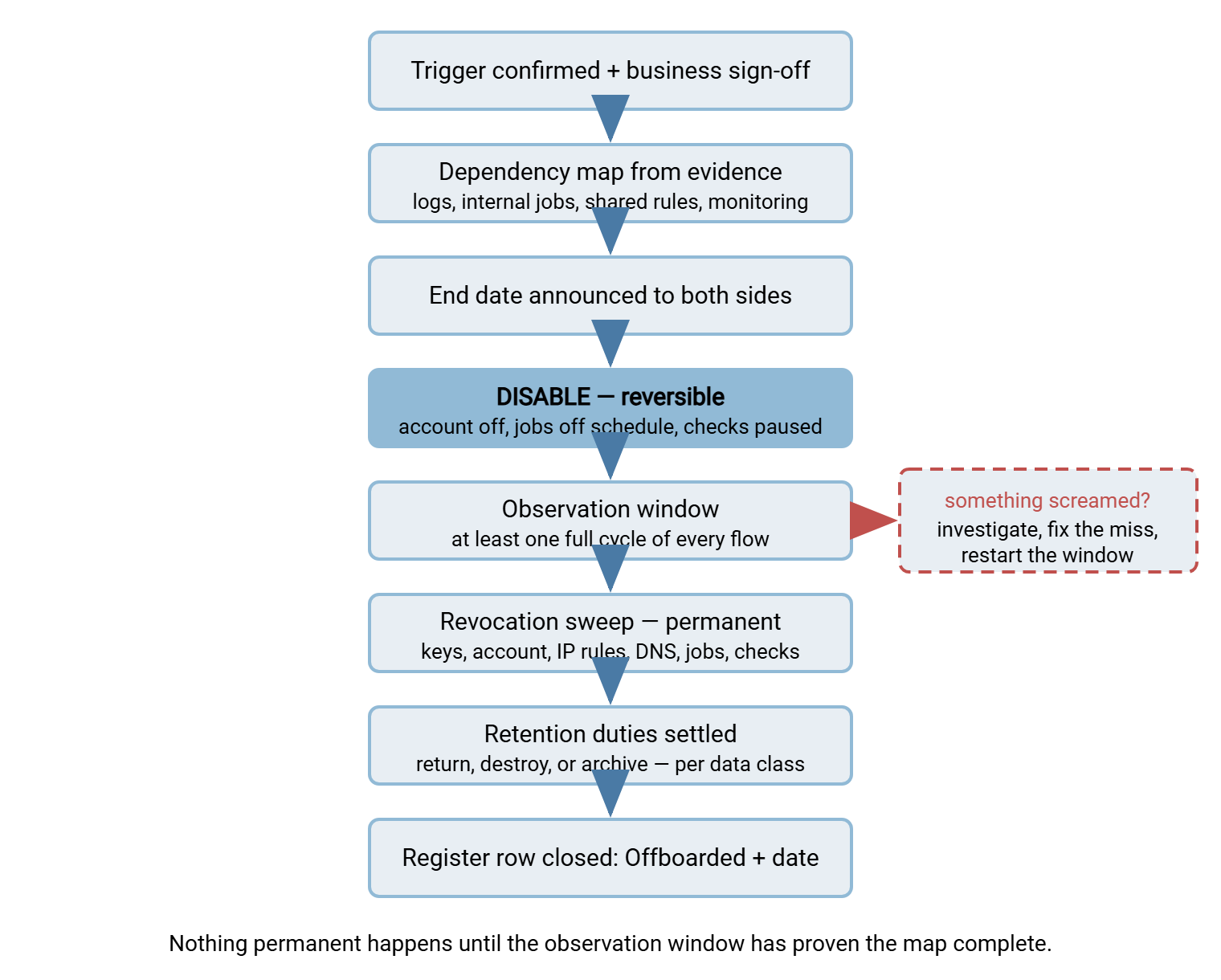
The diagram below shows where the dependency map sits in the full sequence — and the loop that makes the whole thing safe. Nothing permanent happens until an observation window has proven the map was complete.
Disable First, Delete Later
The sequence's safety comes from one principle: every early step must be reversible in minutes. Disabling an account, taking a job off its schedule, pausing a check — all reversible. Deleting an account, its folder tree, its job definitions — not. So the offboarding splits into a soft phase and a hard phase, separated by an observation window in which the estate itself gets to object. The estate has opinions. It expresses them as job errors.
In the soft phase, everything stops but nothing disappears. The partner's account is disabled on the server. Your outbound and fetch jobs for them come off the schedule, and their monitoring checks are paused. Then you wait, and watch for screams. A scream might be human: the partner's operator calling about a refused login they believe is still legitimate, an internal team asking where a feed went. Or it might be mechanical: job errors referencing their folders, or authentication failures from their addresses in the server log. Those authentication failures mean some system of theirs is still trying. Every scream is a dependency your map missed; you fix the miss (sometimes by un-disabling and re-planning), and restart the window. A scream on day three is a gift. Day ninety's scream is the quarterly invoice run.
Size the window by the estate's slowest rhythm, not by the calendar's roundest number. Thirty days is a sensible floor for daily and weekly flows. But a partner with a quarterly invoice run can sit silent for eighty days and still surprise you. So the rule is: the window covers at least one full cycle of every flow the partner ever had. The register's flow list tells you that at a glance. This is also why disabling rather than deleting matters so much: a quarterly surprise during the window is a five-minute re-enable instead of a rebuild from memory. Memory, as a backup medium, has never passed a restore test.
Remember: silence during the window only proves the flows you knew about. The window's length must come from the register's flow list — one full cycle of the slowest flow, minimum — not from a default. The most common offboarding breakage is a monthly or quarterly dependency judged dead after thirty quiet days.
The Revocation Sweep
When the window closes clean, the hard phase runs as a sweep — done in one sitting, from the dependency map, so nothing is left half-revoked:
- Credentials, both directions. Remove the partner's public keys and disable-then-delete (or archive, per your policy) their account. For flows where you connected to them, the mirror matters just as much. In those cases, have them revoke your account on their systems and confirm it in writing. Destroy your stored copy of that credential. The mechanics of clean revocation are the closing chapter of the partner credential lifecycle.
- Network and naming. IP allowlist entries, firewall rules, and any partner-specific DNS names or certificates come out. Each of these is an access path or an operational surface that no longer has an owner.
- Automation. Export the job definitions for the record, then remove the partner's jobs from the automation platform. A job list that mirrors the register is part of what keeps the next census short.
- Monitoring. Retire their checks deliberately and note it, so the next person auditing alert coverage sees an ending, not a gap.
- The server's history stays. Note what you do not sweep: activity logs. On a server like Sysax Multi Server, where partner activity is logged to a file or a database, that history is your organization's record. It is the proof of what was exchanged, and of the silence that justified the offboarding. It follows your log retention policy, not the partner's departure.
Retention: Duties That Outlive the Connection
Revoking access ends the relationship; it does not end your responsibilities to the data. Their folder tree, your archives, and any staged copies hold files that now need a decision. And "leave them there" is the one indefensible option. Storage nobody owns, holding another company's data, is a liability that compounds quietly. Unlike the partner, the data has nowhere else to be.
The decision is per data class, made against three inputs that sometimes pull in different directions. The contract may require return or destruction of partner data within a stated period. Check for a return-or-destroy clause and honor its deadline and its confirmation requirement. Regulation may require the opposite: financial records, tax-relevant invoices, and similar classes often must be kept for years regardless of the relationship's end. And litigation holds trump everything — data under a hold is frozen until the hold lifts, whatever the contract says (see legal holds and exceptions). Where destruction is the outcome, do it properly rather than gesturally. secure deletion basics covers what "deleted" needs to mean. Where retention wins, move the data out of the live partner tree into your archive location, under your retention schedule.
Whatever the mix, write it down: what was returned, what was destroyed and when, what was retained and under which schedule, and who decided. That one paragraph in the offboarding notes is the difference between an answer and a shrug when the question arrives years later. The general framework — schedules per data class, where transfer servers accumulate forgotten copies — is in a retention policy for transfer servers.
The Offboarding Checklist
Everything above, in executable form. Copy it into your ticket template and make every partner ending run it top to bottom:
BEFORE ANYTHING CHANGES
  [ ] Trigger confirmed in writing with the business owner
  [ ] Register row reviewed: flows, schedules, credentials, contacts
  [ ] Dependency map built from evidence:
        [ ] last activity per flow, from server logs
        [ ] internal jobs reading or writing their folders
        [ ] outbound jobs generating or pushing for them
        [ ] allowlist / firewall / DNS / certificate items, checked for sharing
        [ ] monitoring checks watching their flows
  [ ] Retention decision recorded per data class (return / destroy / archive)
  [ ] End date agreed and announced to partner and internal consumers

DISABLE (REVERSIBLE)
  [ ] Partner account disabled on the server (not deleted)
  [ ] Your jobs for this partner taken off the schedule (not deleted)
  [ ] Their expected-file and freshness checks paused
  [ ] Register status set: Offboarding, with the window end date

OBSERVATION WINDOW (ONE FULL CYCLE OF EVERY FLOW, MINIMUM)
  [ ] Server log watched for connection attempts from their addresses
  [ ] No internal job errors or missing-file complaints
  [ ] Any scream: investigate, fix, restart the window

REVOCATION SWEEP (PERMANENT)
  [ ] Partner keys removed; account deleted or archived per policy
  [ ] IP allowlist entries and firewall rules removed
  [ ] Partner-specific DNS names and certificates retired
  [ ] Our credentials on their systems revoked by them, confirmed in writing
  [ ] Job definitions exported for the record, then removed
  [ ] Monitoring checks retired, retirement noted

DATA AND RECORDS
  [ ] Folder tree handled per the retention decision
  [ ] Return or destruction confirmed to the partner where required
  [ ] Activity logs kept under the normal log retention policy
  [ ] Register row closed: Offboarded, date, executed by
  [ ] Offboarding notes filed: kept what, destroyed what, and why
Making Endings Boring: Program Hooks
A checklist executes an ending; the program is what makes endings arrive. Four hooks wire offboarding into the machinery you already run:
- Capture the end at the beginning. The onboarding runbook records the contract end or review date into the register on day one. That is the future trigger, planted while everyone still cares (see the onboarding runbook).
- Sweep for dormancy on a rhythm. The periodic review that already checks credentials and exceptions adds one query: accounts with no activity beyond their longest flow cycle. Each hit gets a one-line inquiry to the business owner.
- Drill the revocation path. The credential portfolio's "revocation tested" practice and offboarding are the same muscle. Every real offboarding is a drill logged. If none has happened in a year, run one on paper against a live partner and time it.
- Keep the platforms mirroring the register. Server accounts, and jobs on the automation platform, should match the register one for one. Your scheduled transfers may live somewhere visible — as named scheduled tasks in a tool like Sysax FTP Automation rather than as scripts scattered across machines. In that case, "which jobs belong to CEDARF?" is a glance during the dependency map. The post-sweep state is then checkable by anyone.
Offboardings also deserve the same courtesy communications as any other planned change. The partner's operators need to know when their access ends and who to call if payroll discovers a dependency in month three. The tone and sequencing translate directly from partner communications for a migration: same channel, same clarity, smaller scope. Partners remember how you left almost as well as how you arrived.
The End Is a Feature
A partner lifecycle with a real ending is what separates a managed exchange program from an accumulation with good intentions. The recipe is short. Listen for triggers you planted at onboarding. Map dependencies from evidence before touching anything, and disable reversibly. Let an observation window sized to the slowest flow prove the map. Then sweep permanently — credentials both directions, network entries, jobs, checks. Settle your retention duties in writing, and close the register row instead of deleting it.
Run that way, endings stop being feared and start being scheduled — and the estate stays the size of the business it serves. "I think so" gets offboarded along with the account. The beginning of the loop is in a partner onboarding runbook that scales. The credential practices that make revocation a five-minute act are in credentials and security across many partners. The register that quietly powered every step of this article is built in running partner exchange as a program.
Frequently Asked Questions
Why not just delete a former partner's account immediately?
How long should the observation window be?
Can we delete the partner's files as soon as they leave?
What about credentials we hold on the partner's systems?
Should the partner's row be deleted from the register afterward?
From the Sysax team: we build secure file transfer software for Windows. Sysax Multi Server is an FTP, FTPS, SFTP, and HTTPS server. Sysax FTP Automation handles scheduled, scripted transfers. Free trials are on the download page.