
The Audit Layer: Proving It Later
"Please confirm that the claims batch transmitted to the processor in early March was delivered complete, and provide records showing who accessed it before transmission." The email arrives on a quiet Thursday, from compliance, with a lawyer copied. The transfer in question happened months ago. It worked — you are fairly sure it worked — but "fairly sure" is not what the lawyer asked for. What the lawyer asked for is evidence, and whether you can produce it was decided long before the email was sent. (Most likely by a rotation setting nobody has read since the install.)
That is the audit layer: the capability to answer questions about transfers long after they happened. The records must be complete enough, intact enough, and well-kept enough to convince a skeptical outsider. The audit layer is the fourth capability that makes file transfer managed. It is the one estates most often discover they lack at the worst possible moment. Unlike a failed transfer, a missing audit trail announces itself only when someone important asks for it.
This article covers the layer end to end. It covers how audit differs from the visibility it grows out of and the five properties that make records evidence-grade. It covers the questions the layer must survive and three maturity levels. It covers an honest build from tools you own and what integrated platforms add. This article is part of our What Makes File Transfer Managed series. It is the capstone over three pillars this library teaches in depth — logging, audit-ready reporting, and chain of custody — linked throughout.
Audit Is Visibility's Serious Sibling
The visibility layer and the audit layer eat the same raw material — transfer logs — which is why people blur them. The difference is audience and stakes. Visibility serves you, now: is everything running, what failed, what's missing? Its records can be informal, because their consumer is friendly and their shelf life is short. Audit serves someone else, later: an auditor, a regulator, a partner's lawyer, a security investigator. That audience is professionally unfriendly, and the questions arrive months or years after the events. Nobody is in a hurry except you.
The audience shift changes the engineering. A log line that helps you troubleshoot ("transfer failed, retrying") may be useless as evidence. That is true if it does not say which account, which file, which byte count, from which address. A log that lives on the server that wrote it is fine for operations and fragile as evidence. It takes one disk failure, one over-eager cleanup script, or one attacker with admin rights. The record of what happened is gone or, worse, quietly changed. Visibility tolerates gaps; audit is defined by their absence. A gap in an audit trail does not just lose one answer — it licenses doubt about every answer the trail gives. I have explained a gap to an auditor exactly once; "the disk was full that week" persuaded nobody, least of all me.
Remember: the cruelest property of the audit layer is that it cannot be built retroactively. Whatever question arrives next year, the records that answer it are being written — or not written — tonight. Every other layer in this series can be adopted when the pain arrives; this one only works if it was already there.
The Five Properties of Evidence-Grade Records
"Keep good logs" is not a specification. Evidence-grade means five specific properties, and each maps to work you can point at:
- Complete. Every session and every transfer event is recorded — successes, failures, and refused logins alike — across every sanctioned endpoint. The field list that makes a record answer who, what, when, where, and outcome is the subject of what to log.
- Attributable. Every event ties to one identity, and every identity ties to one human or one documented service. This property is inherited from the control layer. A shared account converts "who did this?" into "one of four people, probably," which is testimony, not evidence.
- Intact. Nobody — including your own administrators — could have quietly altered or deleted records after the fact, and you can explain why not. The techniques, from append-only copies to hash chains, are covered in tamper resistance for transfer logs.
- Retained. Records survive for a defined period, on purpose. Operational logs rotate in days; obligations run in years. The gap between those two numbers is where audit trails silently die.
- Producible. A question becomes a report in bounded time. Records you cannot search and present might as well not exist — the auditor's clock does not stop while you grep.
Grade your own estate against those five and you will usually find the following picture. The first is nearly true. The middle three are aspirations, and the fifth has never been tested. That is the normal starting point, not a scandal — the build section below takes them in cost order.
The Questions the Layer Must Survive
It helps to know the actual interrogation before designing for it. Four families of questions arrive, in roughly descending frequency:
Auditor questions are the routine kind, and they are more predictable than people fear. Show me all transfers containing this data class for this period. Who can access the outbound payments folder, and who approved each of them? Show me your failed-authentication history for external accounts. What is your retention period for these records? Demonstrate it. Our article on what auditors ask about transfers catalogs them, and much of audit readiness is rehearsing that list. Auditors are the rare audience who hand you the questions in advance.
Dispute questions come from partners: "we never received the file" — or "we sent it, your side lost it." Here the audit layer is your side of a factual argument. The winning move is a record made at the time: session, timestamps, file name, size, completion status. Incident questions come from security: what did this compromised account touch, in what order, from which addresses? Legal questions are the rarest and heaviest: records produced under formal obligation, where intactness and attribution stop being nice properties and become the whole point.
A miniature shows the stakes. A partner disputes an invoice batch: they insist it was uploaded Friday; your processing team saw nothing until Monday. With an audit layer, the answer takes five minutes and ends the argument either way. Perhaps the record shows a session from their account at 17:42 Friday, one file, correct size, completed. Then the fault is on your side of the fence and you say so. Or it shows no session between Thursday and Monday. You can show the complete, gapless record that proves the silence. Without the layer, the same dispute runs for two weeks and is settled by seniority and mood rather than fact.
Your estate may answer to a named framework — healthcare privacy rules, card-industry standards, financial reporting controls. If so, the question list above is not hypothetical but scheduled. Why those regimes care about file transfer specifically, and which records each one expects, is mapped in why regulations care about file transfer. The audit layer described here is the machinery that makes those expectations routine instead of terrifying.
All four families share two traits: none of them can be answered from memory, and none of them warn you in advance. The layer is insurance — priced in steady, boring effort, paid out in moments of high consequence. Dull to build, and the only layer a lawyer ever thanks you for.
Three Maturity Levels
Level zero: the estate remembers nothing
Logs exist — servers write them by default — but they rotate away in days or weeks. They live only on the machines that wrote them and have never been read except during outages. Ask a question about last quarter and the honest answer is that the estate has no memory of last quarter. Most small estates live here, and while nobody is asking questions, it is painless. The estate is not forgetful on purpose; it was never asked to remember. The transition out is usually triggered by the first real question — which is the most expensive possible time. If it produces a formal finding, audit findings as budget language shows how to spend the moment well.
Level one: assembled evidence
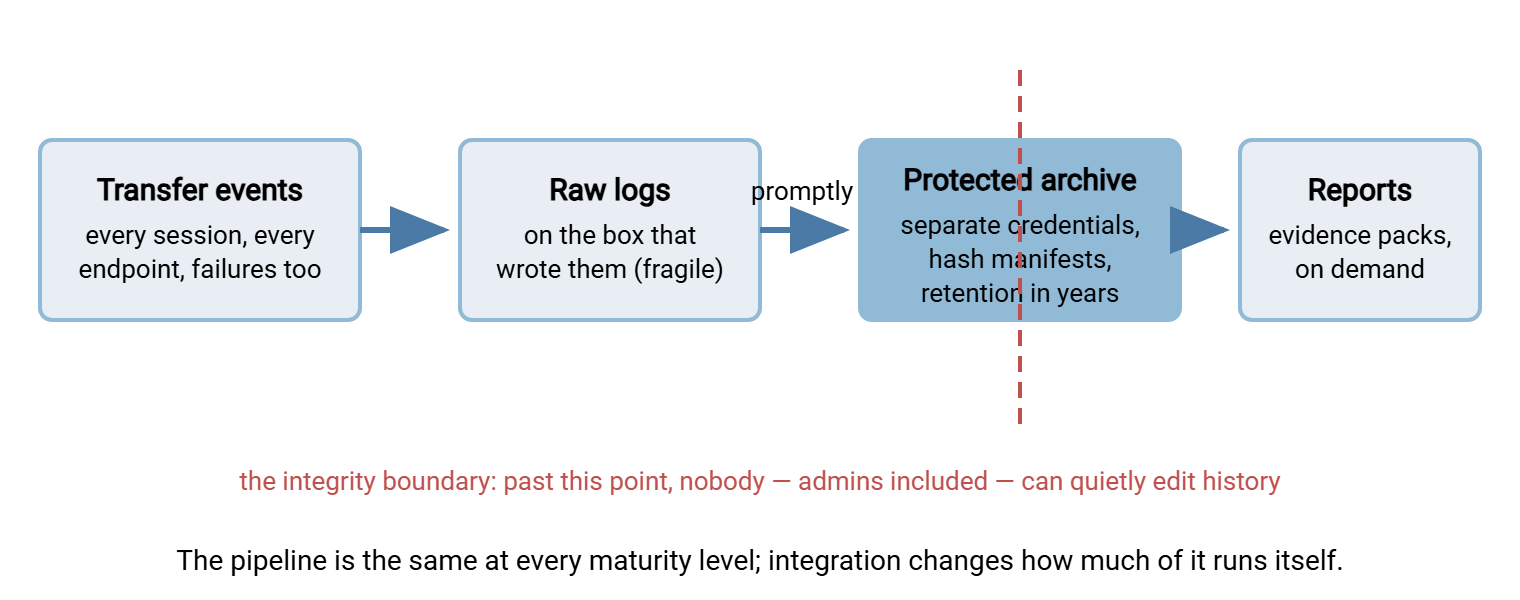
Raw logs from every endpoint are copied promptly to a central archive under separate access control. The archive has integrity protection — even simple hash manifests — and a written retention schedule measured in years, not rotations. Where an archive that old physically lives is the subject of archival tiers for transfer data. Scripted reports answer the predictable auditor questions, and the team has rehearsed producing evidence at least once. This level passes real audits at real organizations. Its costs are the by-now-familiar assembled-build taxes: enrollment of every new endpoint by hand and scripts to maintain. Integrity depends on your own procedures being followed.
Level two: integrated evidence
The transfer platform writes activity records to a database as a side effect of operating. Reports are queries rather than scripts, and retention is configuration. Completeness inherits from the platform — a session that happened is a session recorded. Producibility improves the most: "every transfer by this account in this quarter" is a filtered report, not an archaeology project.
The diagram below draws the assembled pipeline, because its shape is the same at every level. What changes with integration is how much of it the platform does for you.
Building the Layer From What You Already Own
The assembled build, in cost order — each step useful on its own, each one raising the grade of your evidence:
- Capture completely. Turn on full activity logging at every sanctioned endpoint, including authentication failures. Server products generally log more than their defaults show. As one example, Sysax Multi Server can write its activity log to a file or a database. Because it runs as a Windows service, the recording is on whenever the server is. That is capture that does not depend on anyone remembering to start it.
- Move records out of harm's way, promptly. Copy logs on a short schedule to an archive with different credentials than the servers. Then no single compromised account can both do a thing and erase the record of it. This one move is most of tamper resistance for most estates.
- Add integrity you can explain. Hash manifests over each day's archive, stored separately, let you demonstrate later that the files are the files. The full menu, up to chained and witnessed logs, is in tamper resistance — buy only as far up that menu as your obligations demand.
- Write the retention schedule in words. Per record type: what is kept, how long, where, and who may delete. "Transfer activity records: seven years, archive server, nobody without the compliance officer's sign-off." The reasoning that produces those numbers is in retention basics for administrators.
- Script the predictable reports. The auditor list is stable, so pre-build it: transfers per flow per period, account access summaries, failed-login rollups. Our reports worth automating ranks them by payoff.
- Rehearse. Evidence you have never produced is evidence you only think you have. Run the drill below once a quarter.
One subtlety worth building in from the start: absence is evidence too. Half the serious questions are negative — prove nobody outside this list accessed the folder; show there were no transfers of this data after the partner was offboarded. Negative answers are only as strong as your capture is complete. That is why step one includes failed logins and why gaps are fatal. The answer "no record of access" convinces exactly to the degree that a record would certainly exist if access had happened.
THE EVIDENCE DRILL (quarterly, one hour, no preparation allowed)

1. Pick one transfer from roughly ninety days ago — at random,
   from the flow inventory, not a flow you love.
2. Produce, from the archive (not the live server):
   [ ] the session record: account, timestamp, file, size, outcome
   [ ] the human or service that account maps to, and who approved it
   [ ] evidence of delivery (completion status, receipt, or downstream ack)
   [ ] the integrity story: why these records could not have been altered
3. Time it. Under an hour: the layer works. A day of grepping:
   you have logs, not audit. Impossible: you now know, cheaply,
   what the lawyer's email would have taught you expensively.
4. File the drill result itself — a dated record that the audit
   layer is tested is evidence auditors genuinely like.
Bluewater Bank ran the drill for the first time expecting to fail it. The random pick was a settlement file from eleven weeks earlier, sent to a clearing partner over SFTP. The administrator opened the archive and filtered by the partner's service account and the date. In under four minutes, the session record, file name and size, completion status, and that day's hash manifest were on screen. The account-to-owner mapping took longer, because the approval lived in a retired ticketing system. That gap became the quarter's one action item. A genuine dispute with the same partner arrived the following year. The answer came out of the same query before the meeting to discuss it had finished being scheduled. The drill had cost an hour; the dispute cost an afternoon instead of two weeks.
What Integrated Tooling Adds
The disclosure that runs through this series applies with extra force in a section about proof: Sysax sells transfer software. So treat these claims as a vendor's honest account and verify them the way you would verify anyone's. Check them against the five properties, on a trial system, with your own drill.
Integration mainly buys completeness and producibility. When the platform that performs transfers also records them — to a database rather than scattered text files — capture has no enrollment gap. The predictable reports become filtered queries instead of scripts you maintain. Attribution improves wherever the platform's accounts are directory-backed, because the account-to-human mapping is maintained by processes you already run. And where your obligations name cryptographic standards, platform support matters at the protocol level too. Multi Server, to stay with the example above, can operate in FIPS 140-2 mode. That is the kind of specific, checkable claim an auditor's questionnaire actually asks for. It stands against the unfalsifiable "military-grade" adjectives this industry is fond of.
Be equally clear about what integration does not hand you. A platform's database is still a record store an administrator could reach. The separate-credentials archive and the integrity story remain your design work. Retention schedules are still decisions. And the evidence pack an auditor accepts is assembled by a person who understands the estate. It contains records plus explanations plus the account of who could have touched what. The article evidence auditors accept is the guide to that assembly. No product ships with your obligations pre-understood. Ours certainly does not; we have never met your auditor.
The High End: When Proof Must Bind
Everything above proves things to your satisfaction and an auditor's reasonable one. There is a further tier, where proof must bind a counterparty who actively disputes it: non-repudiation. The sender cannot later deny sending; the receiver cannot deny receiving. That tier runs on cryptographic signatures and receipts rather than well-kept logs: signed files, signed acknowledgments, timestamps a third party would credit. Client-side tooling contributes here too. OpenPGP signing and encryption is a built-in step in automation tools like Sysax FTP Automation. It gives a file a verifiable origin and integrity seal that travels with it.
Two honest cautions. First, most estates do not need this tier, and it is a poor reflex purchase. The article non-repudiation for business maps where it genuinely earns its cost, mostly around money movement and formally regulated submissions. Second, you may need to prove a file's whole journey — every hop, every hand, every transformation. That is chain-of-custody territory, a design discipline of its own covered in custody-ready transfer design. The audit layer is the floor those disciplines stand on, not a substitute for them.
The Short Version
Audit is the capability to answer questions months later, from records a skeptical outsider will credit: complete, attributable, intact, retained, producible. It shares raw material with visibility but serves a harder audience. It is the one layer that cannot be adopted after the question arrives — tonight's unlogged transfer is unprovable forever. The assembled build is genuinely attainable: full capture, a separately-credentialed archive, hash manifests, a written retention schedule, scripted reports, and a quarterly drill. Integration removes the capture gap and turns reports into queries, while leaving the obligations, the integrity design, and the explaining to you. With all four layers now on the table, one question remains — how many of them does your estate actually need? That is the honest assessment this series closes with.
Frequently Asked Questions
What is the difference between the visibility layer and the audit layer?
How long should transfer logs be kept?
What makes a log tamper-resistant?
Do I need non-repudiation for my transfers?
Can I build an audit-ready trail without buying an MFT product?
What should I do first if my logs currently rotate away after two weeks?
From the Sysax team: we build secure file transfer software for Windows. Sysax Multi Server is an FTP, FTPS, SFTP, and HTTPS server. Sysax FTP Automation handles scheduled, scripted transfers. Free trials are on the download page.