
What the Future of File Movement Really Looks Like
The slide said "Files are dead." I have seen that slide, or its cousin, at several conferences. Each time, it had a different logo in the corner. And each time I went back to an office where a scheduled job dropped a file somewhere at four in the morning. That was what the partner could consume. Predictions about file transfer have a poor record. FTP was declared dead a generation ago and is still running in your building. Every new wave has promised that everything would become a message, a stream, an API call. Every wave has ended with a batch file and a folder. If you are deciding what to invest in, learn, or build, the last thing you need is another confident forecast with a date on it.
This article makes no dated predictions and names no technology of the moment. Instead it identifies the trends in file movement that are structural. They are driven by pressures that are not going away (hostile networks, heterogeneous partners, auditors who want evidence, the rising cost of human attention). For each trend, it says plainly what it changes for an administrator. Then it does the more useful thing: it says what will still be true a decade from now. That lets you tell durable decisions from fashionable ones. This is part of our Why FTP Won't Die series. See the FTP family tree for where the protocols discussed here came from.
Why Forecasts Fail and Structure Holds
Forecasts fail because they follow fashion, and fashion is about what is new rather than what is needed. Structure holds because it follows pressure. Networks became hostile and stayed hostile, so cleartext retreated and will keep retreating. Organizations exchange data with partners they do not control, so the lowest common denominator keeps mattering. Regulators and customers ask for evidence, so logging and control keep growing. People are the scarcest resource in any IT department, so anything that removes a manual step wins over time. Every trend below is a consequence of one of those pressures. That is why you can rely on it without knowing which product will carry it. (The product will have a new logo. The pressure will not.)
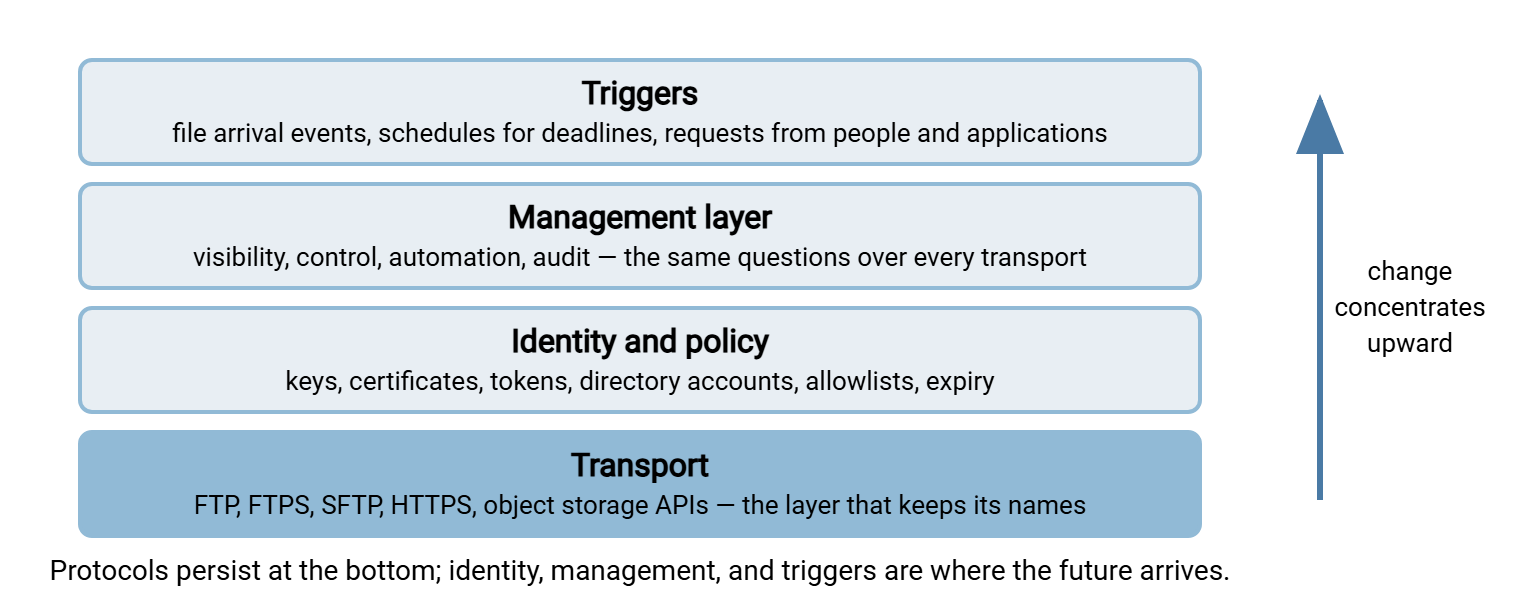
The diagram below shows the shape all of the trends share. The transport protocols at the bottom keep their familiar names. The layers above them, identity, management, and triggers, are where the change actually happens.
Trend One: Identity Replaces the Standing Password
The oldest model of access is an account with a password that never changes. It is shared by whoever needs it, known to a partner's staff who left years ago. A shared partner password never retires; it just changes jobs. Every pressure listed above pushes against it. The structural replacement is identity-centric access: every person, job, and partner has its own identity. That identity is proven by something stronger than a memorized secret. Examples include an SSH key, a certificate, a token issued for a short time, a login federated to a directory. And that identity has a lifecycle: issued, reviewed, rotated, retired. Where a person is involved, a second factor joins the first. Where a machine is involved, the credential is scoped to one flow and one folder, so that its loss costs one flow and one folder.
What this changes for you: stop creating shared partner passwords, starting now, and treat each existing one as an item on a retirement list. Make sure your servers can authenticate against your directory and accept keys or certificates. That way, identity lives in one place rather than in a spreadsheet. Give every flow an owner and an expiry date. Accounts without either have a way of outliving everyone who knew what they were for. See why transfer accounts outlive their owners for more. The zero-trust series lays out the model in zero trust in plain words and identity-centric transfer access. The mechanics of keys are in SSH keys explained. The human side is in MFA for file transfer.
Trend Two: APIs and Object Storage Beside the Protocols, Not Instead of Them
A growing share of file movement no longer looks like a session at all. An application writes an object to a flat storage space, addressed by a name rather than a path. A partner receives a link that carries its own time-limited permission and downloads the file with no account. Another system is told, by an API call, that the file exists and where. This is a genuinely different model (no directory tree, no long-lived login, no client to install). It is winning application-to-application and person-to-system movement for good structural reasons. It fits how modern software is built, and it passes every firewall as ordinary web traffic.
The word that matters is beside. Batches between organizations, scheduled jobs, and anything involving a partner's older systems keep using the protocols. The protocols are the lowest common denominator, and the batch is the unit of business. The result is not replacement but a bridge: a folder that is also a bucket, a server that lands files in one and exposes them through the other. Object storage in file flows describes how the habits differ. The article what the cloud actually changes separates the real shifts from the renamed ones. And hybrid topologies shows the bridge patterns.
Northgate Retail's integration program is the case I think of. It launched with the stated goal of "no more file drops," and its flagship project was the link to the company's largest logistics partner. Eighteen months in, the flagship went live: an API on Northgate's side, beautifully documented. It called a job that wrote a CSV and pushed it over SFTP at ten past four every morning. That was what the partner's warehouse system read and would read for the foreseeable future. Nobody considered it a failure. The API is still there, and so is the file. The final report called the arrangement "hybrid," which was accurate.
What this changes for you: learn to think in objects and links as fluently as in folders and accounts, because you will run both. Design new flows so that the landing place can be a folder today and a bucket later without rewriting the job. And treat a presigned link as what it is, a credential with an expiry. Log its issue the way you would log a login. The article presigned URLs explains the model. And REST API file transfer explains the application side.
Trend Three: A Managed Layer Over Whatever Transport
The questions that matter to a business are not "which protocol?" but "did the file arrive, who sent it, was it changed, what happened next, and can we prove all of that?" Those questions are the same over FTP, SFTP, HTTPS, or an API. The structural trend is to answer them once, in a layer above the transport, rather than separately inside every job. That layer is what the industry calls managed file transfer: visibility, control, automation, and audit, applied to transfers that may use any protocol underneath. The protocol becomes a detail of the endpoint, chosen per partner, while the management is uniform. The same pressure produces the single front door: one gateway that all partners reach. Behind it, the protocols and internal systems can change without anyone outside noticing.
What this changes for you: choose tools for their management, not for the length of their protocol list. Centralize logs in a form you can query. The audit questions will come, and the answer should be a report, not a search. Expect to run several transports for a long time and to want one view over all of them. The MFT series starts in managed file transfer in plain words. The article do you need MFT? is honest about the threshold. And the one-front-door concept covers the gateway pattern. A server that already speaks the whole transport row is a small, concrete example of the principle. Sysax Multi Server answers FTP, FTPS, SFTP, and HTTPS on one Windows machine. It uses the same per-account authentication across all four, including Windows and directory accounts. It also uses the same activity logging to file and database across all four. So the transport is a per-partner setting, and identity and logging are the constants.
Trend Four: Events Replace Schedules, Mostly
The classic transfer job wakes at a fixed time, looks for files, and goes back to sleep, a routine many of us would envy. It is simple and it wastes time twice: files wait for the next run, and runs happen when there is nothing to do. The structural trend is toward event-driven movement: a file arrives, a watch folder or a notification fires, and the next step runs immediately. It is cheaper, faster, and easier to reason about per file. The pressure behind it is the shrinking tolerance for latency between systems and the rising cost of the batch window that used to absorb it.
The word that matters here is mostly. Business runs on periods (month-end, a daily cutoff, a settlement deadline) and those remain schedules by nature. Events handle the movement; schedules handle the deadlines and the checks that nothing was missed. The mature pattern is both, with a clear contract for what "arrived" means. That way, a job never processes a file that is still being written. Event-driven transfers introduces the model. The article arrival contracts and debouncing covers the hard part. And cutoff times and deadlines explains what schedules are still for.
What this changes for you: write new jobs as "when a file arrives that satisfies this contract, do this." Include an explicit settle check and an idempotent action so that a duplicate event is harmless. Keep a small number of scheduled jobs whose purpose is to verify ("by the cutoff, did everything expected arrive?") rather than to move. Tools that do both are the practical middle. Sysax FTP Automation, for instance, runs transfers from folder monitoring as well as from a schedule, with retry and error handling on each. That is an honest example of events and schedules living in one job engine rather than one replacing the other.
Trend Five: Encryption Everywhere, Then Everywhere Inside
Cleartext retreated first from the internet edge, where it obviously could not survive. The structural continuation is its retreat from the interior. "It's internal" has stopped being an accepted justification (some auditors now say so in writing). That is because internal networks carry compromised laptops, contractors, and lateral movement from whatever breach happened elsewhere. And segmentation is now cheap enough to expect. Alongside transport encryption, file-level encryption before sending has become routine for anything sensitive. That way, a file is protected while it sits on an intermediate server, not just while it moves. And the ciphers, certificates, and keys that make all this work have lifecycles that need managing. That turns encryption from a checkbox into an operational routine.
What this changes for you: plan for no cleartext anywhere. Treat each remaining instance as an exception with an owner and an end date rather than a permanent fact. Learn cipher policy well enough to disable weak options deliberately. Put certificate and key expiry on a monitored calendar. The encryption-in-transit series is honest about the limits in what encryption in transit does not cover. The article cipher policy basics covers the settings. And at-rest vs in-transit covers the file-level layer. Finally, segmenting transfer paths covers the interior.
What Will Still Be True a Decade From Now
Everything above is change. What follows is the more valuable list, because it is what you can build on without fear of being wrong:
- Files will exist. A file is the one interface that every system, every era, and every partner can produce and consume without agreeing on anything else first. Systems that have never met exchange files, and that fact does not depend on any technology cycle. Why files still glue systems makes the case in full.
- Batches will exist. Businesses close periods, reconcile totals, and settle on deadlines. A batch is not a technical limitation; it is how organizations agree on what happened by when.
- Partners will be heterogeneous. You will always exchange data with someone whose systems are older, newer, or stranger than yours. The flow will run at the pace of the slower party. The lowest common denominator is a permanent feature of exchange, not a phase.
- Bytes will have to move reliably. Whatever the transport, someone must ensure the file arrived whole, arrived once, and can be shown to have arrived. That means integrity, idempotency, and evidence. Reliable transfer and integrity covers the fundamentals that do not age.
- Someone will own it. Every flow needs a person who knows what it does and what happens when it fails. No layer above the transport removes that; the good ones make it easier. Flow ownership and contacts is how you write the name down.
Remember: the transports keep their names; the layers above them change. If a decision would still be right regardless of which protocol or product carries it, it is a structural decision. That includes one identity per flow, no cleartext, central logs, explicit arrival contracts, an owner for everything. It is safe to make that decision today.
The Durable Trends at a Glance
| Trend | The pressure behind it | What it means structurally | What this changes for you |
|---|---|---|---|
| Identity over standing passwords | Credential theft is the common breach | One identity per flow, proven by keys, certificates, or tokens, with a lifecycle | No new shared passwords; directory-backed servers; owners and expiry dates |
| APIs and object storage beside protocols | Software is built around web calls | Objects and links for applications; protocols for batches and partners; bridges between | Design flows whose landing place can change; log links like logins |
| A managed layer over transport | Auditors and customers want evidence | Visibility, control, automation, audit answered once for all protocols | Choose tools for management; centralize logs; one front door |
| Events over schedules, mostly | Batch windows shrink; latency costs | Arrival triggers movement; schedules guard deadlines | Arrival contracts, settle checks, idempotent actions, verification jobs |
| Encryption everywhere | Interiors are no longer trusted | Cleartext becomes an exception; keys and certificates become routine operations | Exceptions with end dates; cipher policy; expiry on a calendar |
Decisions That Will Still Be Right
The test for a durable decision is simple: would it still be correct if every product in your estate were replaced? The list below passes that test. It is written as a checklist you can attach to any new flow, server, or partner onboarding:
FUTURE-SAFE CHECKLIST FOR A NEW FLOW OR ENDPOINT

[ ] Endpoints are addressed by name, never by a hard-coded IP address
[ ] The flow has exactly one identity, used nowhere else
[ ] That identity has an owner, a purpose, and a review or expiry date
[ ] Identity is proven by a key, certificate, token, or directory login -
    not by a password sent by email
[ ] No cleartext transport, internal or external; exceptions are written down
    with an end date
[ ] Every transfer is logged centrally with who, what, when, where, and result
[ ] The flow is described as a contract: source, destination, trigger,
    what "arrived" means, how integrity is verified, what happens on failure
[ ] Movement is triggered by arrival where possible; a scheduled check guards
    the deadline
[ ] The action is idempotent: running it twice on the same file is harmless
[ ] The landing place could become a bucket or a folder without a rewrite
[ ] A migration plan exists for any legacy piece, even if it sits on a shelf
[ ] Someone can say, from memory, what happens if this flow fails tonight
Nothing on that list names a protocol, and that is the point. Run the list against an existing FTP flow and it also becomes a diagnosis. The items it fails are the costs counted in what FTP's persistence costs. The items it can pass (a unique identity, central logging, a contract, an owner) are the containment measures in living with FTP responsibly. When you evaluate a new server or tool, the same list is a better starting point than any feature comparison. Our series on choosing a transfer server builds the requirements from there.
The Version to Tell a Colleague
The future of file movement is not the death of any protocol. It is the steady migration of what matters (identity, management, triggers, encryption) into layers above the transport. The transports themselves persist for as long as some partner or device needs them. Files, batches, heterogeneous partners, and the need to move bytes reliably will outlast every product on the market today. That means the durable investments are the ones that would survive a change of product. They are unique identities, no cleartext, central logs, explicit contracts, and an owner for every flow. Make those decisions now, and the rest of the future can arrive at whatever pace it likes. The slide will be back next year with a new logo. The four-in-the-morning job will be there too.
Frequently Asked Questions
Will SFTP eventually be replaced the way FTP is being replaced?
Should new integrations use an API instead of file transfer?
Is managed file transfer a product I have to buy?
Do event-driven transfers make scheduled jobs obsolete?
What is the single most future-proof change I can make this year?
From the Sysax team: we build secure file transfer software for Windows. Sysax Multi Server is an FTP, FTPS, SFTP, and HTTPS server. Sysax FTP Automation handles scheduled, scripted transfers. Free trials are on the download page.